




Salary negotiation practice — say your number out loud before the real conversation.
Most people lose the negotiation in the first ten seconds: they soften the number, fill the silence, or accept the first “that’s above our band”. Rehearse it with an AI recruiter or manager that holds the budget line, pushes back the way real ones do, and tells you afterwards where you gave money away.
No credit card · Voice or text · 7 languages · Your real numbers stay private
12 salary talks people rehearse before the real one
Pick the one on your calendar — or the one you keep postponing — and run it until the number comes out of your mouth without a wobble.
- Countering a job offer
- “What are your salary expectations?”
- Asking for a raise
- Annual performance review
- Promotion without a pay rise
- Taking on a second role
- Fixed bonus instead of variable
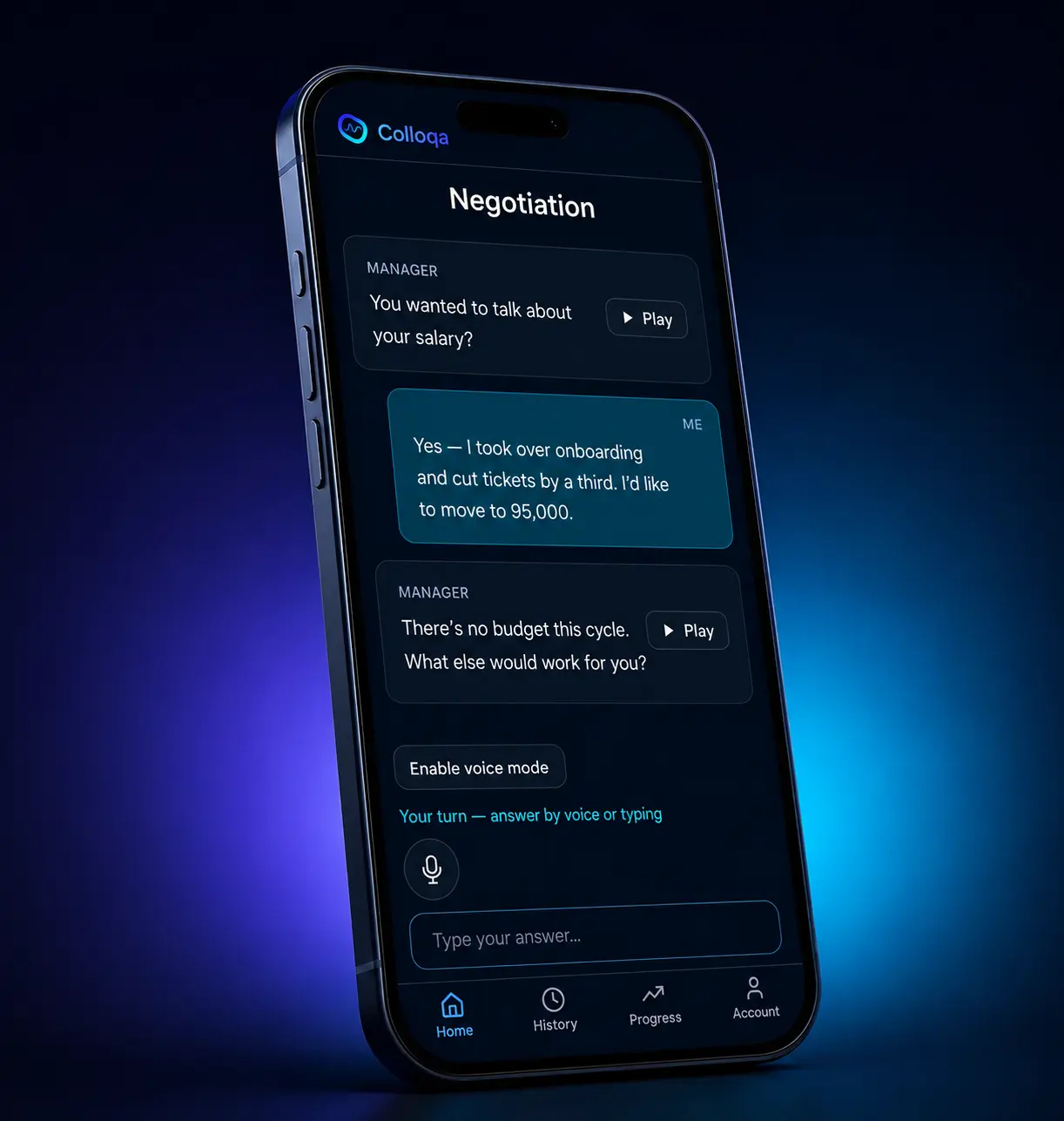
- “There’s no budget this year”
- A competing offer
- Equity vs. base salary
- Sign-on bonus
- Remote days and title, not just money
How to negotiate salary — 6 steps
Works for a new offer and for a raise with your current manager. This is the structure the feedback scores you against; most people lose money at step 3 (softening the number) or step 5 (conceding without getting anything back).
Know three numbers before you walk in
Your target (what you ask for), your floor (below this you say no) and the market range for the role, level and city from salary data you can name. Plus your alternative if it falls through — another offer, staying put. Without a floor you will negotiate against yourself.
Let them move first on the number if you can
Asked for expectations early, redirect once: “I’d like to understand the full scope first — what range is budgeted for the role?” If they insist, give a range whose bottom is a number you would happily accept.
Anchor with one specific number and one reason
“Based on the scope and what the market pays for this level, I’m looking for 128,000.” A specific figure reads as researched; a round one reads as a guess. One reason, not five — every extra justification sounds like doubt.
Then stop talking
The silence after your number is where most people give money away — “…but I’m flexible”. Let them answer. Rehearsing out loud is the only way to find out how long three seconds actually feels.
Trade, don’t cave
When they say the budget is fixed, move to the rest of the package instead of the number down: sign-on bonus, an earlier salary review in writing, title, equity, remote days, a fixed bonus instead of a variable one. Every concession you make gets something back.
Close it in writing
Repeat what was agreed — number, start date, review date, anything non-salary — and ask for it in the written offer or a follow-up email. A verbal “we’ll revisit in six months” without a date is not an agreement.
Lines people rehearse here
- Countering a job offer
“Thank you — I’m excited about the role. Based on the scope and what the market pays for this level, I was expecting 128,000. Is there room to get there?”
- “What are your salary expectations?”
“I’d like to understand the full scope first. What range have you budgeted for this role?”
- Asking for a raise
“Over the last year I took over the onboarding flow and cut support tickets by a third. I’d like to talk about moving my salary to 95,000 to reflect that.”
- “There’s no budget this year”
“I understand. Then let’s put the review date in writing — can we agree on March, with this number as the target — and talk about a one-off bonus now?”
Built for the number you’ve been rehearsing in the shower
Three people who use this most. If one of them is you — run the conversation tonight, with your real numbers.
An offer on the table, below your number
You have 48 hours and a recruiter who says the band is fixed. Rehearse the counter, the first no and the “is that your final number?” — so on the call you ask once, clearly, and don’t accept the first figure out of relief.
A raise you’ve been putting off
You’re doing more than a year ago and paid the same. Practise opening the conversation with your boss, the evidence in two sentences, and what to say when they answer “not this cycle”.
More scope, same pay
A promotion without a raise, a second role on top of yours, a variable bonus that never pays out. Rehearse turning “we really value you” into a number, a fixed bonus or a date in writing.
What makes this better than practising in the mirror
Six things that turn “I should negotiate” into actually saying the number and holding it.
A counterpart that holds the budget line
Not a bot that says yes when you ask nicely. The AI recruiter or manager pushes back — “that’s above our band”, “we don’t negotiate on base”, “is that your final number?” — until your argument actually earns the move.
Your real numbers and your real alternative
Enter the role, the offer or current salary, your target, what you know about their position and your walk-away option. The AI argues from inside that — and the numbers stay in your account.
Say it out loud — voice mode
The hard part isn’t knowing the number, it’s saying it without a wobble and then staying quiet. Voice mode rehearses exactly that: pace, pauses, the silence after your ask. 7 languages.
Feedback on where money was left
Did you anchor high enough? Soften the number? Concede without getting anything back? The read names the moves and the likely outcome — not a vague “be more confident”.
Drill the moment you fold
Cave on the first “no budget”? Over-explain your number? One tap turns that one moment into a short, focused drill you can repeat until it holds.
Private to your account
Your salary, your offer and your employer’s name stay with you. No training on your sessions, no sharing, voice isn’t stored.
Hear the no before it counts.
Practice freeWhat a rehearsed salary conversation looks like
The recruiter holds the line, you counter, they test you — then a short read on what you won and what you gave away.
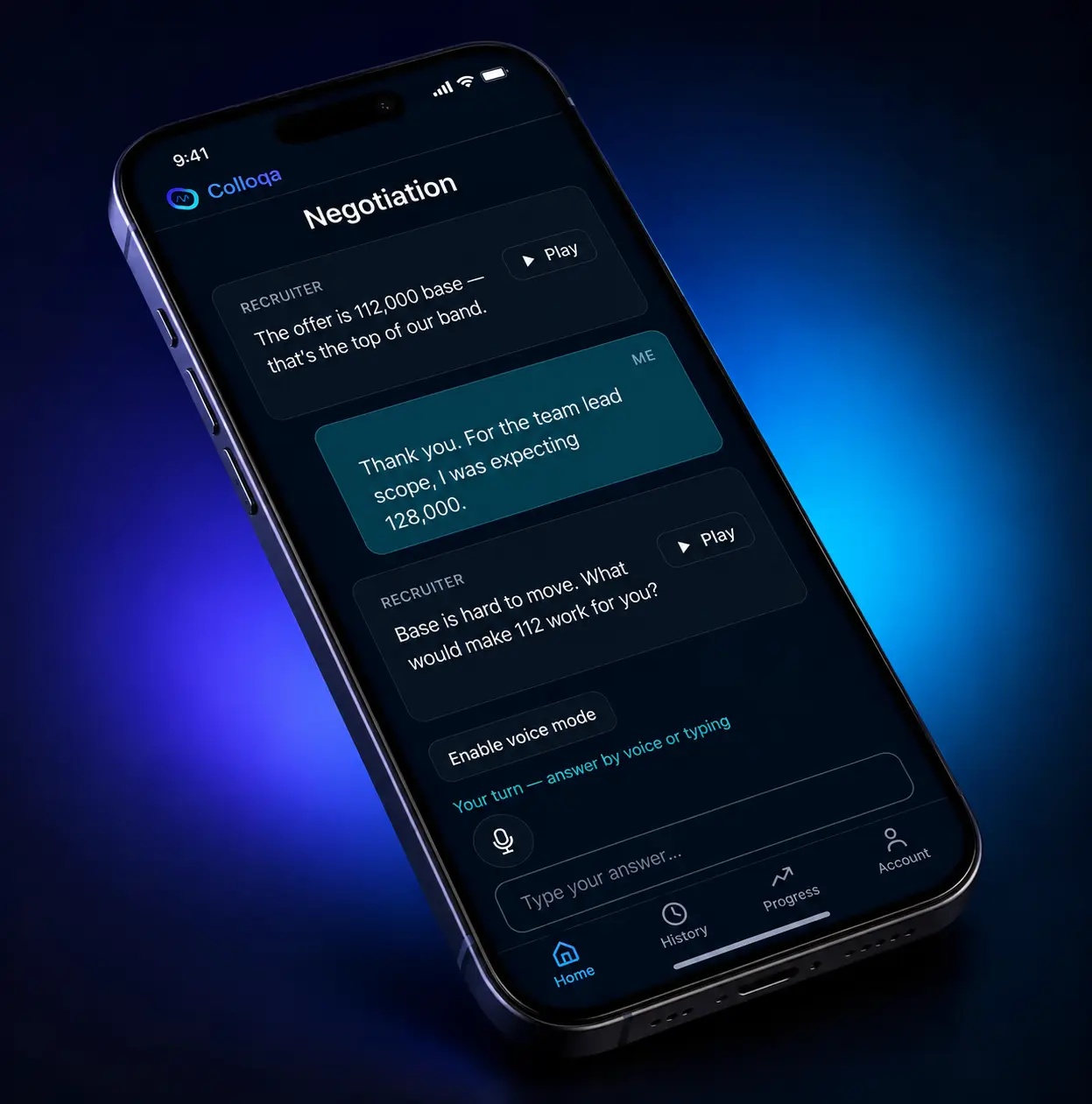
Looks useful? Run it with your real offer — none of it leaves your account.
Start your first rehearsalHow it works
Four steps. The whole loop fits in 10 minutes.
Pick your scenario
Job interview, negotiation, hard personal talk, or the hiring manager’s seat — choose what you need to rehearse today.
Set the context in 60 seconds
A short quick-setup quiz captures who you are, what you want, who you’re talking to. The AI uses this to play the other side in character.
Practice out loud — or by typing
Voice mode in 7 languages with natural TTS / STT. The AI pushes back, probes, holds positions — like a real counterpart, not a static chatbot.
Get coaching feedback
Strengths, growth areas, and tactics to try next time. One-click "Drill this" to rehearse a specific weakness in a focused 5-8-turn session.
That's the whole loop. First session takes less than a minute to set up.
Start practicing freeQuestions people ask before a salary negotiation
The things we hear most. Missing one? Email support.colloqa@gmail.com.
Colloqa’s salary negotiation practice is an AI role-play for the money conversation: you enter your role, the offer or current salary, the number you want and your walk-away alternative, then negotiate out loud with an AI recruiter, hiring manager or boss that argues from a real budget — and get feedback on your anchor, how you handled the first no, what you conceded and what you got in return.
Thank them, then counter with one specific number and one reason: “Based on the scope and what the market pays for this level, I was expecting 128,000 — is there room to get there?” Then stop talking. If base won’t move, trade on the rest of the package — sign-on bonus, an earlier review in writing, equity, title — rather than dropping your number. Get whatever you agree in the written offer.
Redirect once: “I’d like to understand the full scope first — what range have you budgeted for the role?” If they insist, give a researched range whose bottom is a number you would genuinely accept, because they will hear the bottom. Rehearsing this line out loud matters — it is the question people answer too fast and too low.
Ask for a dedicated meeting rather than raising it in passing, open with what changed — scope, results, the market — in two sentences, name one specific number, and stop. If the answer is “not this cycle”, ask what would need to be true and agree a date in writing. The AI plays your manager with their real constraints so you can hear “no budget” before it counts.
Treat it as information, not a final answer. Ask whether it is the number or the timing, then move to what can move: a one-off or sign-on bonus, a salary review date in writing, a fixed bonus instead of a variable one, title, remote days, training budget. The mistake is lowering your number in the same breath — that is the moment the feedback flags most often.
Yes — that is the point. In setup you describe your role, the offer or current salary, your target, what you know about their position and your walk-away alternative. The AI plays the recruiter, hiring manager or boss in character and holds the line. Everything stays private to your account and is not used for training.
Yes — voice and text in English, Ukrainian, Polish, Spanish, Portuguese, German and French, and you can switch language mid-conversation. Useful if the real negotiation is in your second language.
The free tier is one full rehearsal a day with voice — no credit card. If you want to run the same conversation several times in one evening, drill the one move you keep missing and get the detailed feedback, that comes with a subscription: $8.99/week or $19.99/month, cancel anytime, 7-day money-back guarantee.
No more questions? Try it with the conversation that’s actually on your mind.
Try Colloqa freeThe conversation isn't going away.
Better to have it twice — with the AI first.
Free to start. One minute to set up. No prep required.
Start practicing free