




Behavioral interview questions, rehearsed until every story ends with a clear result.
An AI interviewer that asks the behavioral questions your panel will — conflict, failure, pressure, leadership — and follows up on the part of your story that was vague. Coaching feedback after every session.
No long forms. Paste the job posting or just name your role — start rehearsing in 60 seconds.
7 languages · Real follow-up questions · Practice out loud
12 competencies — the ones behavioral questions are built to test
Every “tell me about a time” question is a probe for one of these. Set your role and the AI interviewer leans on the ones that job cares about most.
- Teamwork
- Conflict resolution
- Handling failure
- Working under pressure
- Leadership
- Adaptability
- Prioritization
- Taking initiative
- Customer focus
- Receiving feedback
- Problem solving
- Influencing without authority
The STAR method: how to structure a behavioral interview answer
Interviewers score behavioral answers against roughly this shape. Most answers fall apart at A or R — too much “we”, and no outcome.
Situation
One or two sentences of context — where, when, what was at stake. Enough for the interviewer to picture it. The most common mistake is spending half the answer here.
Task
What you specifically were responsible for — not the team’s goal, yours. This is what makes the rest of the answer about you.
Action
The bulk of the answer: the two or three things you did, in order, and why you chose them. Say “I”, not “we”. This is where the follow-up questions land.
Result
What changed because of it — a number if there is one, a concrete outcome if not — plus one sentence on what you would do differently. An answer without a result sounds unfinished.
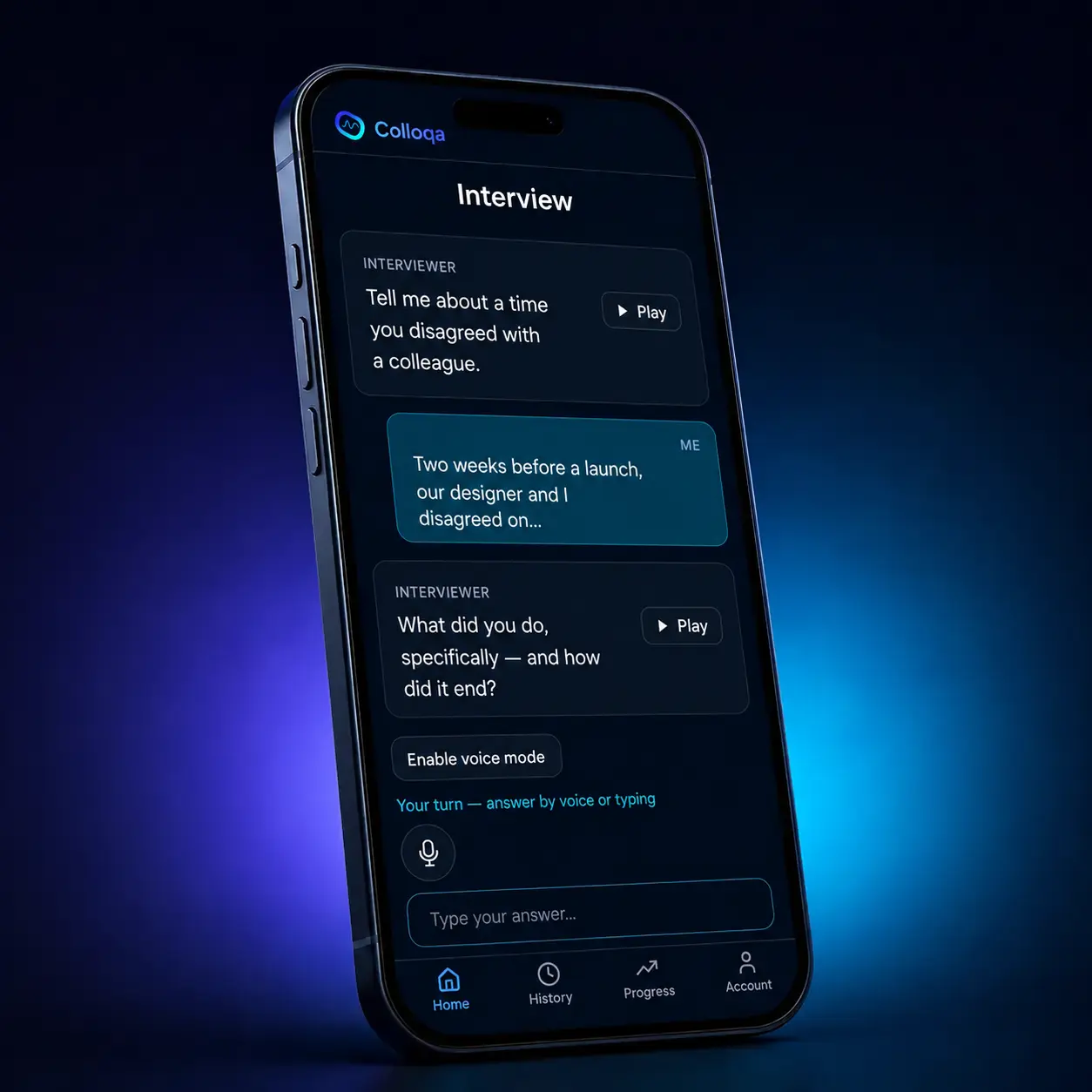
What each part sounds like — “Tell me about a time you disagreed with a colleague”
- Situation
“Two weeks before a launch, our designer and I disagreed on whether to cut the onboarding tutorial to hit the date.”
- Task
“I owned the launch checklist, so it was on me to get us to a decision that day — not to win the argument.”
- Action
“I asked for thirty minutes, pulled the drop-off data from the last release, and proposed a three-screen version instead of all or nothing.”
- Result
“We launched on time and onboarding completion went from 41% to 55%. Since then I bring data to a disagreement before opinions.”
Top 10 behavioral interview questions (and what a strong answer sounds like)
The “tell me about a time” questions that come up in almost every interview, whatever the role — and the ones Colloqa’s AI interviewer will ask you, with follow-ups, until your stories come out in shape.
Tell me about a time you disagreed with a coworker or your manager.
They are testing whether you can disagree without damage. Show that you raised it directly, argued with facts, and committed fully once the decision was made — even if it wasn’t yours.
Tell me about a time you failed.
A real failure with a real cost, not a disguised strength. One sentence on what went wrong; the rest on what you did next and what you do differently now.
Describe a time you worked under a tight deadline.
Everybody “worked hard”. The signal is what you dropped or renegotiated, how you decided what mattered, and who you warned early.
Tell me about a time you showed leadership.
It doesn’t need a title. Pick a moment you moved people who didn’t report to you — and say how you got them to agree, not only that they did.
Give an example of a goal you set and reached.
The goal with its number, how you tracked it, and the week it nearly slipped. A straight line from goal to success sounds invented.
Tell me about a time you made a mistake.
Own it in the first sentence. Then: how quickly you flagged it, what you did to limit the damage, and what you changed so it can’t repeat.
Describe a time you had to adapt to a big change.
Show the moment you stopped resisting it and started working with it. The strongest answers include one thing you did to help others through the same change.
Tell me about a time you dealt with a difficult customer or stakeholder.
What they actually needed underneath the complaint, what you said first, and how it ended. Staying polite is the baseline, not the answer.
Tell me about a time you received critical feedback.
Quote the feedback plainly, admit the sting briefly, and show the specific change it produced — ideally one someone else noticed.
Describe a time you had to juggle several priorities at once.
How you ranked them — impact, deadline, who was blocked — and who you told what would slip. Juggling without a system sounds like luck.
Knowing the question is not the same as answering it out loud, with a follow-up coming.
Rehearse these out loudBuilt for the days before the interview
Three situations Colloqa is made for. If one sounds like this week — start there.

You have the experience, but your stories come out as rambles
You did the work — but “tell me about a time” makes you start at the beginning of the project and never reach the point. Practice until the story fits in two minutes and ends on a result.

There’s a behavioral round and you’re not sure your examples are enough
Most panels ask six to eight of these. Build a bank of stories that covers conflict, failure, leadership and pressure — and find out which ones hold up when the interviewer digs in.

You’re early in your career and your examples feel small
Class projects, part-time jobs and volunteering count — if they’re told well. Rehearse turning a small moment into a clear STAR story, so it sounds like judgment, not filler.
What makes the rehearsal worth 15 minutes
Six things that turn talking-to-a-bot into real prep for the behavioral round.
An interviewer that actually follows up
A behavioral answer is only as strong as its second layer. Colloqa asks for it — "What did you do, specifically?" "How did you know it worked?" — the follow-ups that expose a story you haven’t really thought through.
Practice out loud — voice mode
A STAR answer that reads well on paper can still take four minutes to say. Rehearse out loud and hear exactly where your story drags.
Behavioral, technical, or mixed
Run a pure behavioral round, or a realistic mix of behavioral and role questions — the format most interviews actually use.
Coaching feedback, not a transcript
After each session: how well your stories were structured, how specific they were, and whether you owned them — "I decided", not "we did".
Drill the one thing you fumbled
Ran out of story on "tell me about a time you failed"? One tap turns it into a short, focused drill so you have a crisp version before the interview.
Watch your readiness trend up
Re-run the questions and watch your readiness climb across attempts. Built for the days before the interview — not a one-shot demo.
Walk in with stories you’ve already told out loud — and already been questioned on.
Practice freeWhat a rehearsal actually looks like
A real behavioral question, your answer, the follow-up a real interviewer would ask — then written coaching at the end.
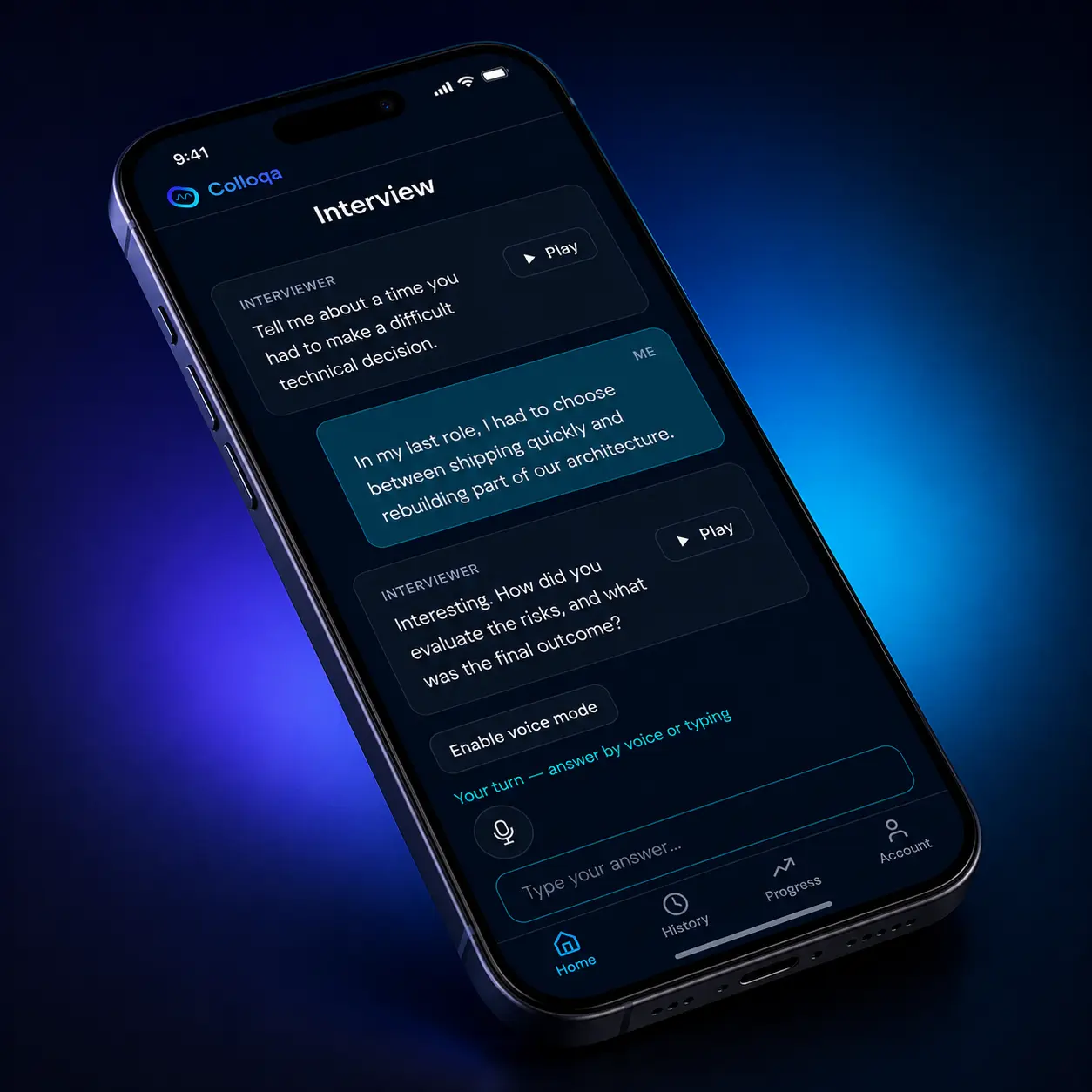
Looks useful? Run a session yourself — your transcript and feedback work the same way.
Run your first interviewHow it works
Four steps. The whole loop fits in 10 minutes.
Pick your scenario
Job interview, negotiation, hard personal talk, or the hiring manager’s seat — choose what you need to rehearse today.
Set the context in 60 seconds
A short quick-setup quiz captures who you are, what you want, who you’re talking to. The AI uses this to play the other side in character.
Practice out loud — or by typing
Voice mode in 7 languages with natural TTS / STT. The AI pushes back, probes, holds positions — like a real counterpart, not a static chatbot.
Get coaching feedback
Strengths, growth areas, and tactics to try next time. One-click "Drill this" to rehearse a specific weakness in a focused 5-8-turn session.
That's the whole loop. First session takes less than a minute to set up.
Start practicing freeQuestions about behavioral interview practice
The objections we hear most. Missing one? Email support.colloqa@gmail.com.
An interview built on questions about what you actually did in past situations — “tell me about a time you…” — on the principle that past behavior is the best predictor of future behavior. Almost every interview includes some, whatever the role. Colloqa’s behavioral interview practice is an AI interviewer that asks these questions out loud, follows up on the weak part of your answer, and gives you coaching feedback afterwards.
Situation, Task, Action, Result — the structure interviewers expect a behavioral answer to follow: brief context, what you were responsible for, what you did (the longest part), and what changed because of it. Colloqa’s feedback scores what STAR is for — structure, specificity, and ownership (“I” rather than “we”) — so you see which part of the story thinned out.
Yes. Set your role and level in the quick setup — or paste the job posting — and the AI tailors the behavioral questions and follow-ups to it. A nurse and a software engineer get different “tell me about a time” questions.
A list shows you the question; it doesn’t ask you the next one. Colloqa behaves like an interviewer — it follows up instead of agreeing, voice mode makes you say the story out loud, and you get structured coaching afterwards rather than a wall of text.
That’s the main thing it fixes. Nerves come from unfamiliarity. Telling your stories two or three times, with follow-ups, makes them feel routine — so on the day they are already there instead of something you’re inventing under pressure.
Yes. Colloqa supports 7 languages for both the questions and your spoken answers, so you can rehearse in the language you’re most comfortable in, or practice in English to get used to interviewing in it.
The free tier is a full AI mock interview once a day — no credit card. With an interview coming up, back-to-back mock interviews, focused drills and the detailed feedback come with a subscription: $8.99/week or $19.99/month, cancel anytime, 7-day money-back guarantee.
No more questions? One short rehearsal beats an hour of reading interview tips.
Try Colloqa freeThe conversation isn't going away.
Better to have it twice — with the AI first.
Free to start. One minute to set up. No prep required.
Start practicing free