




Rehearse your customer service interview until every answer sounds calm and customer-first.
An AI interviewer that role-plays the hiring manager — de-escalating an angry customer, handling call volume and metrics, working remotely across time zones — and follows up like a real one. Get coaching feedback and fix your weak spots before the interview or the mock call.
No long forms. Set your role, start rehearsing in 60 seconds.
12 languages · Real follow-up questions · Practice out loud
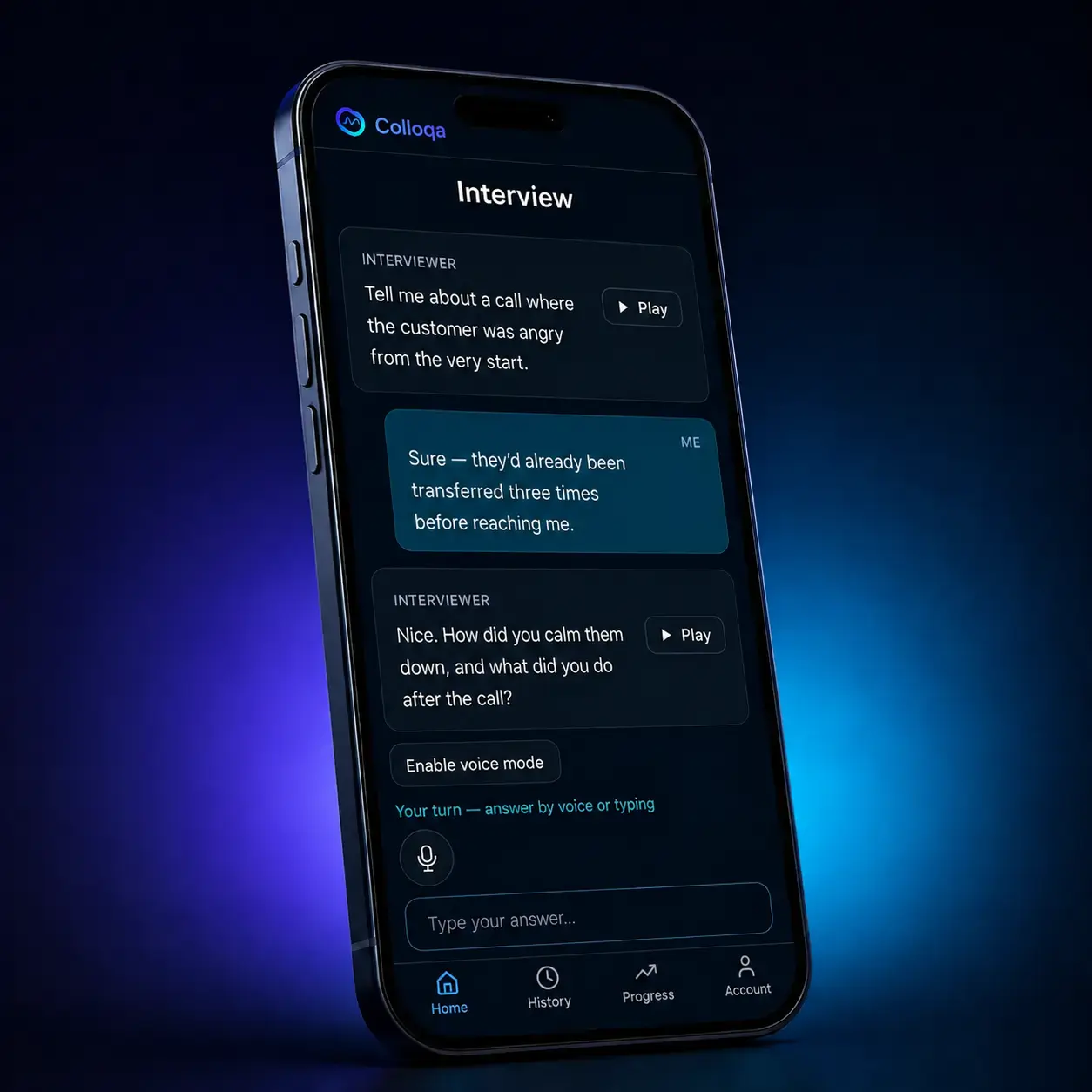
CSR to team lead — rehearse the exact role you’re applying for
Phone, chat, or email — in an office or fully remote: people rehearse the real interview they’re walking into, with the customer scenarios and situational questions a support or BPO employer actually asks.
- Customer Service Representative
- Call Center Agent
- BPO Associate
- Technical Support Agent
- Chat Support Specialist
- Virtual Assistant
- Executive Virtual Assistant
- Healthcare Virtual Assistant
- Real Estate Virtual Assistant
- Contact Center Agent
- Customer Support Executive
- Customer Success Associate
- Customer Care Advisor
- Appointment Setter
- Help Desk Analyst
- Customer Service Team Lead
16 customer service interview questions (and what a strong answer sounds like)
These are the questions a support, BPO, or call center hiring manager actually asks — customer service and call center interview questions in one list — and the ones Colloqa’s AI interviewer will ask you, with follow-ups, until every answer sounds calm.
Tell me about yourself.
Frame it around customers: where you’ve dealt with people (a job, a shop, volunteering), one thing you’re good at in those conversations, and why support is the next step. Under ninety seconds — on a phone screen your pace is being judged too.
What does good customer service mean to you?
Skip the slogan. Describe it as outcomes: the problem is actually solved, the customer knows what happens next, and they didn’t have to repeat themselves. Then one short example of you doing exactly that.
How would you deal with an angry customer?
Walk through the order: let them finish, acknowledge the specific problem, say what you can do right now, and follow up if it can’t be solved on the call. Interviewers want the steps, not “I stay calm”.
Tell me about a time you went above and beyond for a customer.
One customer, what they needed, and the extra step that wasn’t in the script — a call back, a note for the next agent, a fix for the root cause. Show judgment: going further within policy, not giving everything away.
What do you do when you don’t know the answer to a customer’s question?
Honesty plus a process: tell the customer you’ll find out, check the knowledge base or ask a lead, and give a realistic time. Never guess — a wrong answer just creates a second contact.
How do you handle repetitive work and back-to-back calls?
Call center managers are thinking about burnout. Describe what keeps you consistent — a reset between calls, treating each customer as the first of the day — and what you do after a rough one.
Which customer service metrics are you familiar with?
Name the ones you know — handle time, first-contact resolution, customer satisfaction — and how you balance them. The trap is sounding like you’d rush a customer to hit a number; say how you keep quality while staying efficient.
Tell me about a time a supervisor or quality review gave you critical feedback.
Support teams coach constantly, so this tests coachability. Name the feedback without defending yourself in the retelling, then say what you changed on the next calls.
What’s your biggest weakness in customer-facing work?
Pick a real one that won’t sink the role — over-explaining, struggling to close a chatty call — and the specific thing you do about it. “I care too much” gets an eye-roll.
Why do you want to work in customer service?
“I like helping people” is what everyone says. Say what you actually like about the moment a problem gets solved, or about talking to strangers all day, and point to a time you did it — a job, a shop, a volunteer line. Managers hire people who will still like it in month four.
Tell me about a time you turned an unhappy customer around.
One customer, what they were really upset about underneath the complaint, the first thing you said, and what you did that they didn’t expect. End with how it finished — a thank-you, a kept account, a good survey score — not with “they calmed down”.
A customer asks for something that’s against policy. How do you say no?
The order matters: acknowledge what they want, say clearly what you can’t do and why in one sentence, then move straight to what you can do. Show you don’t hide behind “policy” and don’t cave either; mention when you’d escalate rather than argue.
How do you handle several chats or a queue of calls at the same time?
Describe your actual method — how many chats you take at once, how you keep each customer informed while you work another, which macros or notes you use — and what you do when the queue is beyond you: tell the lead early, not after the wait times blow up.
Tell me about a time you worked with another team to solve a customer’s problem.
Support rarely owns the fix. Pick a case you had to hand to billing, tech, or logistics: how you briefed them so they didn’t need to re-ask the customer, how you stayed the customer’s single contact, and how you closed the loop. It shows you own the outcome, not just the ticket.
How do you stay calm when a customer is rude or swearing at you?
Be honest that it lands, then give the technique: slower voice, their name, a short acknowledgment, and the line you use to bring it back to the problem. Say where your limit is — when you warn, when you end the call — because managers want to know you’ll protect yourself and the brand.
Do you have any questions for us?
Ask how long training lasts, how calls or chats are reviewed, and what the best agents on the team do differently. For a remote role, ask about schedules and how the team stays in touch during a shift.
Reading them is not the same as answering them out loud with a recruiter on the line.
Rehearse these out loudBuilt for the days before the interview
Three situations Colloqa is made for. If one sounds like this week — start there.

You know the "angry customer" question is coming and you don’t want to wing it
De-escalation, a time you went the extra mile, a policy you couldn’t bend — customer service interview questions are predictable, but rambling through them is common. Rehearse the exact ones tonight, get told where the answer dragged, and tighten it until it lands in a minute.

It’s a remote or BPO role and the interview doubles as a communication test
Your tone, pace, and clarity on the call are being scored as much as your answers. Practice out loud, hear how you actually sound, and walk into the phone screen or mock call already comfortable.

You’re moving up — agent to team lead, receptionist to VA, support to success
The questions change when you interview to lead a queue or run a client’s inbox solo: coaching others, hitting metrics, staying organised without supervision. Rehearse the format you’re actually walking into.
What makes the rehearsal worth 15 minutes
Six things that turn talking-to-a-bot into real prep for a customer-facing or remote support role.
An interviewer that actually follows up
Real hiring managers push on the scenario. Colloqa does too — "And what if the customer still wanted to escalate?" — so you practice de-escalating on your feet instead of reciting a script.
Practice out loud — voice mode
Support and call center roles are judged on how you sound. Rehearse your tone, pace, and clarity out loud — the closest thing to the phone screen or mock call you’ll actually face.
Behavioral, situational, or mixed
Pick the format your interview runs — an angry-customer role-play, "tell me about a time you went the extra mile", or a realistic blend of both.
Coaching feedback, not a transcript
After each session: what landed, what to fix, and how to say it — empathy, ownership, clear next steps, and staying composed under pressure.
Drill the one thing you fumbled
Froze on "how would you handle a customer you can’t help"? One tap turns it into a short, focused drill so you nail it before the interview.
Watch your readiness trend up
Re-run the questions and watch your readiness climb across attempts. Built for the days before the interview — not a one-shot demo.
Walk into the phone screen feeling like you’ve done this interview twice already — because you have.
Practice freeWhat a rehearsal actually looks like
A real opening question, your answer, an honest follow-up — then written coaching at the end.
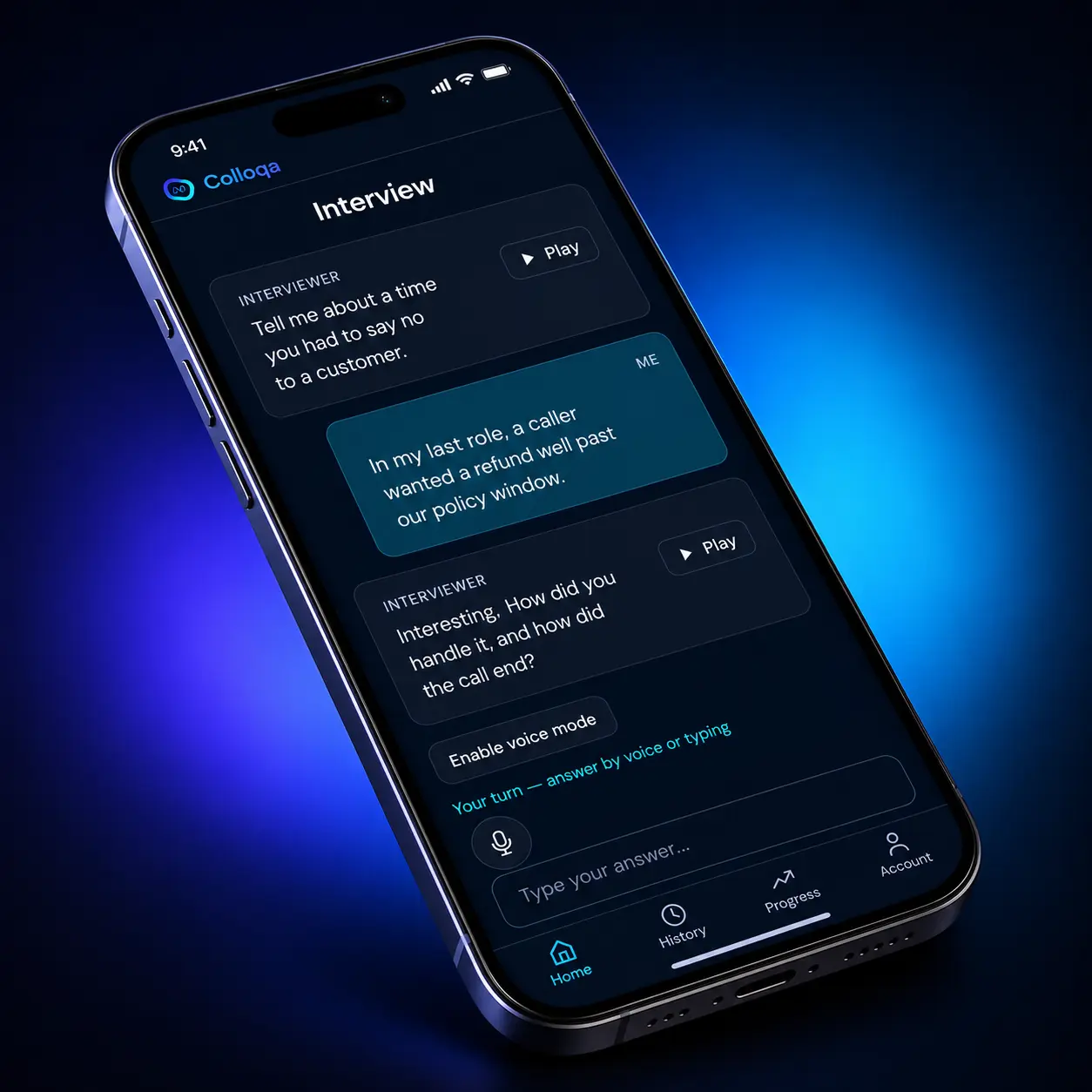
Looks useful? Run a session yourself — your transcript and feedback work the same way.
Run your first interviewWatch a full customer service interview role play
Five real questions for an entry-level customer service rep at an internet provider, the answers and the score at the end. Setup is sped up and marked on screen; the candidate’s answers are re-voiced with AI from the app’s transcript, two of them lightly corrected where speech recognition misheard.
How it works
Four steps. The whole loop fits in 10 minutes.
Pick your scenario
Job interview, negotiation, hard personal talk, or the hiring manager’s seat — choose what you need to rehearse today.
Set the context in 60 seconds
A short quick-setup quiz captures who you are, what you want, who you’re talking to. The AI uses this to play the other side in character.
Practice out loud — or by typing
Voice mode in 12 languages with natural TTS / STT. The AI pushes back, probes, holds positions — like a real counterpart, not a static chatbot.
Get coaching feedback
Strengths, growth areas, and tactics to try next time. One-click "Drill this" to rehearse a specific weakness in a focused 5-8-turn session.
That's the whole loop. First session takes less than a minute to set up.
Start practicing freeQuestions customer service & call center applicants ask us
The objections we hear most. Missing one? Email support.colloqa@gmail.com.
The ones a support, call center, or BPO hiring manager actually asks: "Tell me about a time you dealt with an angry customer", "How do you handle a customer you can’t help", "Why customer service", "How do you stay calm with a queue building up" — plus role-specific ones for chat support, technical support, and virtual assistants. Set your role and level in the quick setup and the AI tailors the questions and follow-ups.
Yes. It role-plays the scenario questions that make up most of a call center or BPO interview and follows up the way a real interviewer would. Voice mode is the closest thing to the phone screen or mock-call round — you answer out loud, hear how you sound, and get coaching on tone and clarity as well as content.
Many call center and BPO employers add a simulation or assessment to the hiring process: you handle mock customer calls or chats — often with an upset customer — while they look at how you listen, show empathy, find the right information, and actually resolve the issue. Some versions also test typing or navigating a practice system; Colloqa doesn’t cover those parts and doesn’t replicate any employer’s or vendor’s test. What it rehearses is the spoken part: set up an angry-customer role-play, handle it out loud in voice mode while the AI pushes back the way a frustrated caller would, then get feedback on tone, empathy, and clarity. The free tier gives you one full session a day.
It is. Virtual assistant interviews mix customer service questions with "how do you stay organised without supervision", the tools you use, and handling a client’s inbox or calendar. Paste the job post into the setup — executive VA, healthcare VA, real estate VA — and the questions follow it.
Yes, and that’s a common reason people use it for support roles. Practice the interview in English to get comfortable being assessed in it, or rehearse in one of 12 supported languages first and switch. The feedback covers clarity and pace, not just what you said.
An interviewer persona that pushes back instead of being polite, voice mode so you actually practice speaking the way a phone interview requires, and structured coaching at the end — strengths, growth areas, drill targets — instead of a wall of text.
The free tier is a full AI mock interview once a day — no credit card. If your interview is days away and you want back-to-back mock interviews, drills and the detailed feedback, they come with a one-time pass: $9.99 for 1 week, $19.99 for 1 month or $49.99 for 3 months. Nothing renews, and there is a money-back guarantee (7 days; 3 days on the 1-week pass).
No more questions? One short rehearsal beats an hour of reading interview tips.
Try Colloqa freeThe conversation isn't going away.
Better to have it twice — with the AI first.
Free to start. One minute to set up. No prep required.
Start practicing free