




Nursing interview questions, rehearsed until you answer with calm confidence.
An AI interviewer that role-plays the hiring panel — patient scenarios, compassion, handling pressure and difficult families — and follows up like a real one. Get coaching feedback and steady your nerves before the interview.
No long forms. Set your role, start rehearsing in 60 seconds.
7 languages · Real follow-up questions · Practice out loud
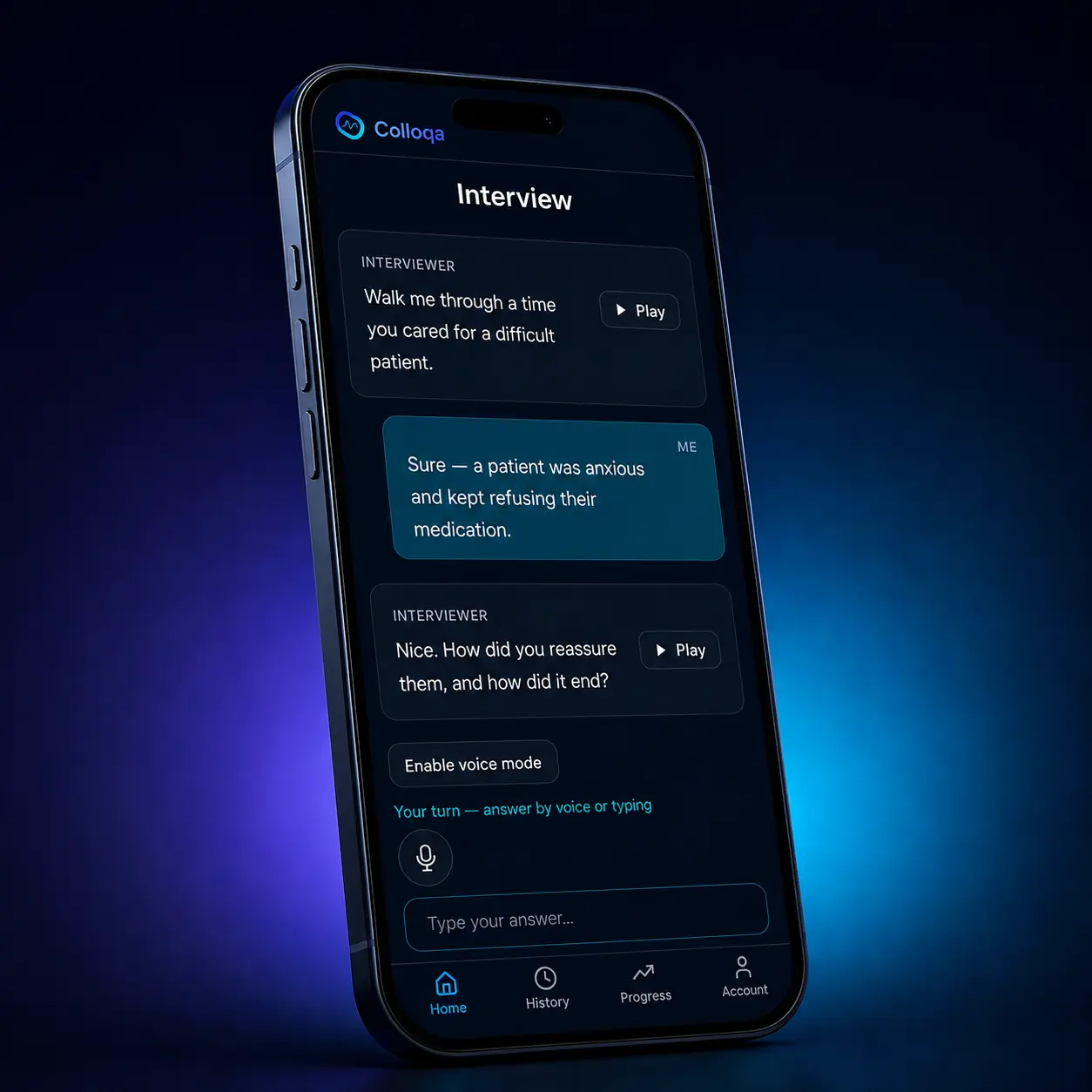
CNA to registered nurse — rehearse the exact role you’re applying for
Bedside, clinic, or front desk: people rehearse the real interview they’re walking into — the patient scenarios and behavioral questions a healthcare panel actually asks.
- Certified Nursing Assistant (CNA)
- Registered Nurse (RN)
- Licensed Practical Nurse (LPN)
- Caregiver
- Home Health Aide
- Patient Care Technician
- Medical Assistant
- Medical Office Assistant
- Medical Receptionist
- Dental Assistant
- Phlebotomist
- Pharmacy Technician
- Care Coordinator
- Aesthetician
- Physical Therapy Aide
- Care Support Worker
Top 10 nursing interview questions (and what a strong answer sounds like)
These are the questions a nursing panel actually asks — and the ones Colloqa’s AI interviewer will ask you, with follow-ups, until the answers come out steady.
Tell me about yourself.
Not your CV read aloud. Three beats: where you work now and with which patients, one thing you’re known for on the unit, and why this role is the next step. Sixty to ninety seconds.
Why did you choose nursing?
Panels hear “I want to help people” all day. Name the specific moment or person that made it concrete, then connect it to how you actually work now.
Tell me about a time you handled a difficult patient or family member.
Pick one real situation. What they were actually frightened or angry about, what you said first, and what changed. The de-escalation is the answer — not the fact that you stayed polite.
You have four patients who all need you at once. How do you prioritise?
They want your triage logic out loud: who is unstable, what can be delegated, what can wait ten minutes, when you escalate. Name the framework you use (ABCs, acuity) rather than saying “I just manage”.
Tell me about a mistake you made — or an error you caught.
Never “I can’t think of one”. Say what happened, what you did in the next five minutes (patient first, then report it), and what you changed so it can’t repeat. Owning it is the thing being tested.
How do you handle a disagreement with a physician or a colleague?
The safe answer isn’t deference. Show that you raised the concern, gave the clinical reason, and knew the escalation path if it wasn’t resolved — while keeping it away from the bedside.
Describe a time you had to give difficult news or sit with a distressed family.
Panels listen for presence, not scripts. What you did before speaking (found a room, sat down, silenced the pager), what you said plainly, and what you did not promise.
How do you cope with the stress of this job?
“I’m fine, I just get on with it” reads as a retention risk. Give the concrete things — debriefing with a colleague, your routine after a bad shift — so they hear someone who lasts.
Tell me about a time you advocated for a patient.
One patient, one thing going wrong, what you pushed for and to whom. Include the friction — an advocacy story where everyone agreed instantly isn’t advocacy.
Do you have any questions for us?
Always yes. Ask about ratios, the orientation period, and who you’d go to on your first hard shift. It shows you’re picturing the job — and tells you whether you want it.
Reading them is not the same as answering them out loud with someone waiting.
Rehearse these out loudBuilt for the days before the interview
Three situations Colloqa is made for. If one sounds like this week — start there.

You’re strong with patients but freeze answering questions about it
You’re great on the floor — but "describe a time you handled a difficult patient" makes you go blank. Practice turning what you do naturally into a clear, confident answer.
You know the scenario questions are coming and you want them tight
Patient safety, a mistake you caught, working under pressure, an upset family member — the scenarios are predictable. Rehearse them, get told where your answer wandered, and sharpen it.

You’re new to the field or stepping up a level
First clinical role, or CNA moving toward RN — the format and expectations shift. Rehearse the interview you’re actually walking into, not the one you did years ago.
What makes the rehearsal worth 15 minutes
Six things that turn talking-to-a-bot into real prep for a patient-facing role.
An interviewer that actually follows up
A real panel probes your judgment. Colloqa does too — "What did you do when they still refused?" — so you practice reasoning aloud, not reciting.
Practice out loud — voice mode
Bedside manner is heard, not written. Rehearse compassion and clarity out loud so it comes through even when your nerves are up.
Behavioral, situational, or mixed
Pick the format your interview runs — patient-scenario role-plays, "tell me about a time" behaviorals, or a realistic blend.
Coaching feedback, not a transcript
After each session: strengths, growth areas, and concrete fixes — empathy, safety, and communication — in the language you practiced in.
Drill the one thing you fumbled
Froze on the difficult-family question? One tap turns it into a short, focused drill so you can steady it before the interview.
Watch your readiness trend up
Re-run the questions and watch your readiness climb across attempts. Built for repeat practice — not a one-shot demo.
Walk into the panel feeling like you’ve done this interview twice already — because you have.
Practice freeWhat a rehearsal actually looks like
A real opening question, your answer, an honest follow-up — then written coaching at the end.
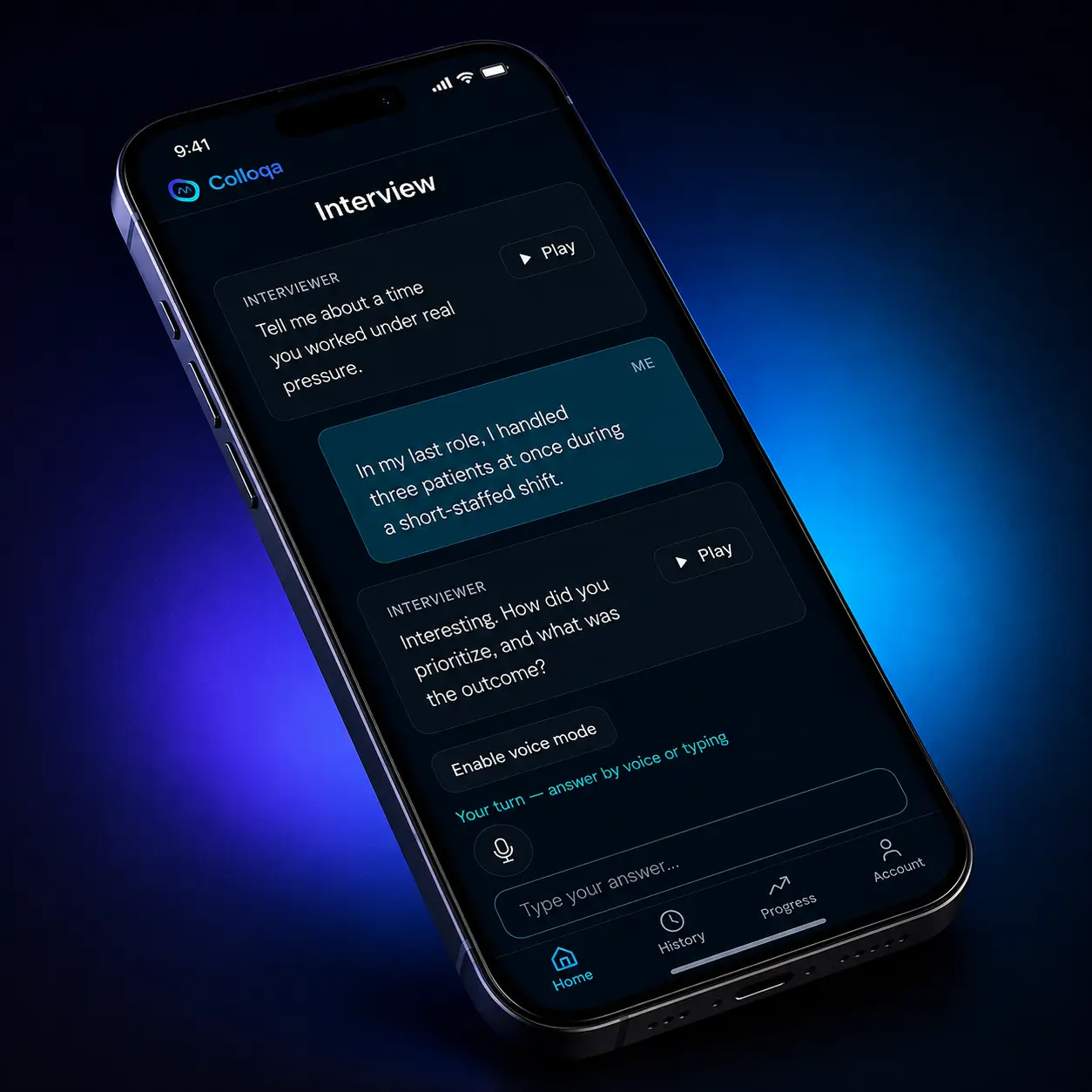
Looks useful? Run a session yourself — your transcript and feedback work the same way.
Run your first interviewHow it works
Four steps. The whole loop fits in 10 minutes.
Pick your scenario
Job interview, negotiation, hard personal talk, or the hiring manager’s seat — choose what you need to rehearse today.
Set the context in 60 seconds
A short quick-setup quiz captures who you are, what you want, who you’re talking to. The AI uses this to play the other side in character.
Practice out loud — or by typing
Voice mode in 7 languages with natural TTS / STT. The AI pushes back, probes, holds positions — like a real counterpart, not a static chatbot.
Get coaching feedback
Strengths, growth areas, and tactics to try next time. One-click "Drill this" to rehearse a specific weakness in a focused 5-8-turn session.
That's the whole loop. First session takes less than a minute to set up.
Start practicing freeQuestions healthcare applicants ask us
The objections we hear most. Missing one? Email support.colloqa@gmail.com.
It role-plays the kind of questions a healthcare hiring panel asks — patient scenarios, compassion and communication, safety, handling pressure and difficult families, and "tell me about a time" behaviorals. Set your role and level in the quick setup and the AI tailors its questions and follow-ups to it.
Verbal scenario questions — yes, that’s its strength. It’ll present a situation ("a patient refuses medication…") and follow up on your reasoning and bedside approach. It is not a clinical-knowledge test bank; it practices how you talk through and handle situations, which is what interviews actually judge.
Yes. Colloqa supports 7 languages for both the questions and your spoken answers, so you can rehearse in the language you’re most comfortable in, or practice in English to get used to interviewing in it.
A believable interviewer that follows up instead of being agreeable, voice mode so you practice speaking with warmth and clarity out loud, and structured coaching afterwards — strengths, growth areas, drill targets — rather than a wall of text.
That’s the main thing it fixes. Nerves come from unfamiliarity. Running the real questions two or three times makes them feel routine, so on the day your answers are already there instead of something you’re inventing under pressure.
The free tier is a full AI mock interview once a day — no credit card. With an interview coming up, back-to-back mock interviews, focused drills and the detailed feedback come with a subscription: $8.99/week or $19.99/month, cancel anytime, 7-day money-back guarantee.
No more questions? One short rehearsal beats an hour of reading interview tips.
Try Colloqa freeThe conversation isn't going away.
Better to have it twice — with the AI first.
Free to start. One minute to set up. No prep required.
Start practicing free