


Panel interviews: what they are, common questions, and how to prepare
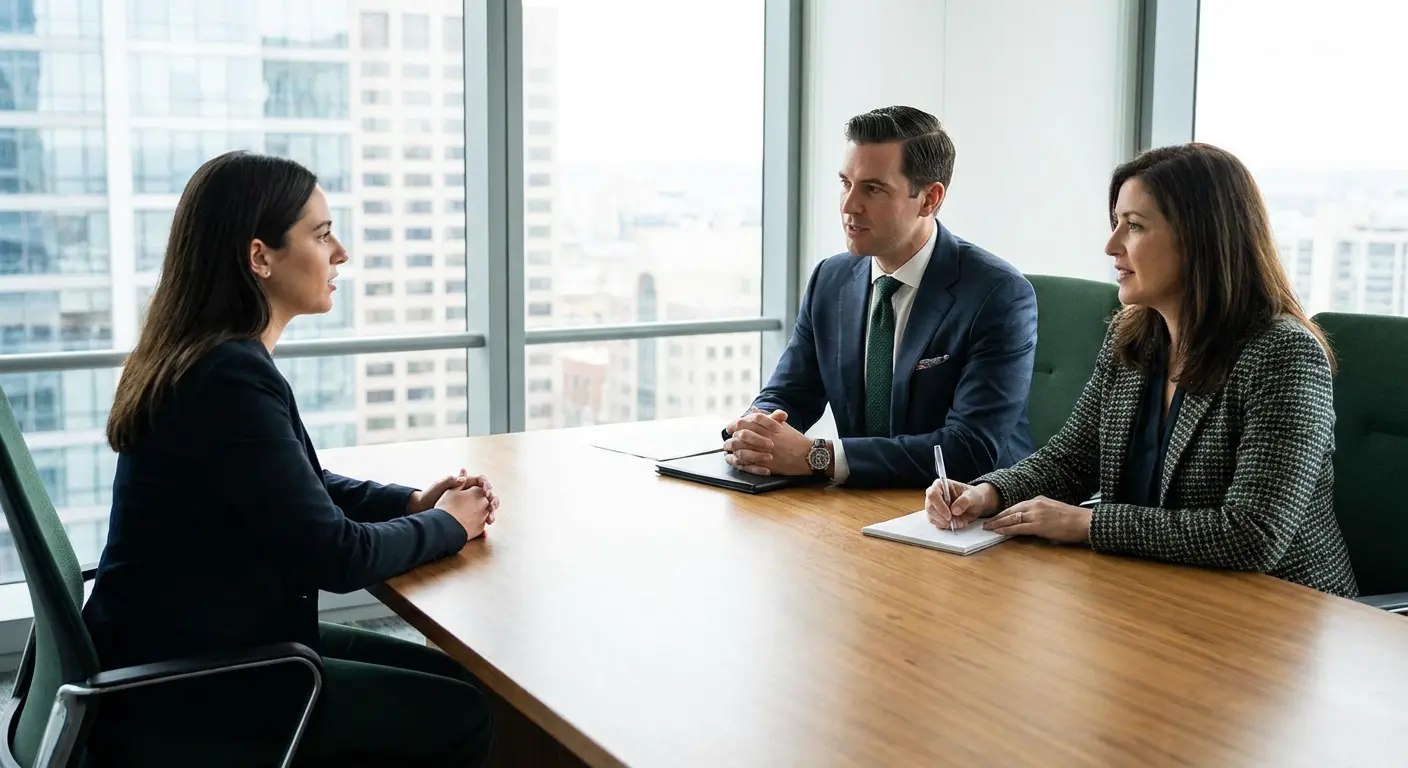
In a panel interview you meet several interviewers at once instead of one after another. It feels harder than it is: the questions are mostly the same as in any interview, and panels are usually more structured and fairer than one-to-one conversations. What changes is how you prepare and how you handle the room. Below: what a panel interview is and who sits on it, the questions you are likely to hear and how to answer them, example answers, how to prepare, and how to come across well to several people at once — in person or on video.
Free: 1 full practice interview a day, no card.
What a panel interview is
A panel interview is a single interview with two or more interviewers, usually three to five, who all ask questions and all have a say in the decision. Typically the panel is the hiring manager, someone from HR, and one or two people you would work with; for senior roles, a more senior leader or someone from another department joins.
Panels are common in healthcare, education, government and the public sector, universities, and at larger companies, and often in the second or final round. They tend to be structured: every candidate gets the same questions, often in the same order, and each panel member scores your answers on their own sheet before they compare notes. That is why panels feel formal — and why a clear, specific answer to the question asked matters more than rapport with one person.
A panel interview is not the same as a group interview. In a group interview, several candidates are assessed together, often through a group task; in a panel interview, it is you and several interviewers.
Who sits on the panel, and what each person listens for
Panels often split the questions by area. Knowing who is in the room tells you which examples to have ready.
- The hiring manager. Your future boss. Listens for whether you can do the work and how you would approach the team’s main problems. Usually leads the interview and asks the role-specific and scenario questions.
- HR or the recruiter. Listens for motivation, values, how you work with others, and red flags. Often asks the behavioral questions and covers logistics.
- A future teammate or peer. Listens for what you would be like to work with day to day. Expect practical questions about how you do the work and handle disagreements.
- A stakeholder from another team. Listens for how you would work with their team — communication, priorities, handoffs. Common for roles that sit between departments.
- A senior leader. Joins for senior roles or final rounds. Listens for judgement, impact and how you think about the bigger picture.
Common panel interview questions, and how to answer them
Most panel interviews are built from these groups. Because each person scores separately, answer the question that was asked, with one specific example, in a minute or two.
Opening
- Tell us about yourself. Often asked by whoever leads. A 60–90 second answer: where you are now, one or two things that fit this role, and why you applied. Look around the whole panel while you answer.
- What do you know about our organization, and why do you want to work here? Name something specific — a service, a project, a value — and connect it to your own reason. Panels in the public sector and healthcare often weigh this heavily.
Behavioral and competency questions
The core of most panels. Each one is usually tied to a requirement in the job posting.
- Tell us about a time you worked with a difficult colleague or stakeholder. Show how you stayed professional, understood their position, and found a way forward — and what happened.
- Describe a time you had to manage several priorities at once. How you decided what came first, who you told, and whether everything got done.
- Give an example of a mistake you made and what you learned. A real mistake, owned without excuses, with what you fixed and what you changed afterwards.
- Tell us about a time you improved a process. What was wrong, what you changed, and a result you can measure — time saved, errors reduced, people helped.
- Describe a situation where you had to deliver bad news. Common in healthcare, customer-facing and management roles. Show that you were direct, kind and clear about next steps.
Role and scenario questions
- How would you handle [a situation from this job]? Panels often bring a realistic case. Ask a clarifying question if needed, then talk through your steps and why. They score the reasoning, not a perfect answer.
- What would you focus on in your first 90 days? Learn first — the people, processes and priorities — then one or two early results tied to what the panel has told you matters.
- How do you stay current in your field? A specific answer: what you read, a course you took, how you used something you learned.
Teamwork and fit
- How would your colleagues describe you? Quote something real — from a review, a reference, a thank-you. One or two words with an example beat a list of adjectives.
- How do you like to be managed? Honest but flexible. What helps you do your best work, and how you adapt to different styles.
Closing
- Is there anything else you would like us to know? Use it. Add one strength or example you have not mentioned that fits the role, in two or three sentences.
- Do you have any questions for the panel? Have three or four ready, ideally one that fits each person on the panel.
Example answers
Use them for the shape, not the words. Each takes about a minute to a minute and a half out loud.
“Tell us about a time you worked with a difficult stakeholder.” — project coordinator
“On a system rollout last year, the head of finance kept pushing back on the timeline in every meeting. I asked for thirty minutes with her one-to-one and found out the real issue: the go-live date fell on her month-end close. We moved her team’s training a week later and kept the overall date. After that she became one of the people helping us get other departments on board.”
A specific person, the real cause, what you did, and the result.
“Describe a situation where you had to deliver bad news.” — nurse
“A patient’s family was expecting a discharge that afternoon, and the doctor decided to keep him another night after new test results. I went to the family before they heard it from anyone else, explained what had changed and what would happen next, and gave them a time when the doctor would come to talk to them. They were disappointed, but they told the manager later that they felt kept in the loop.”
Direct, kind, with clear next steps — what the panel scores on this question.
“How would you handle a scenario from this job?” — customer service team lead
“Can I check one thing first — is the customer threatening to cancel, or asking for a refund? … OK. I’d call them back the same day rather than reply by email, listen first, and confirm what went wrong. Then I’d offer what I can do within policy, set a date to follow up, and log what happened so we can see if it’s a pattern.”
A clarifying question, then a clear, step-by-step answer.
“Do you have any questions for the panel?”
“Yes — a couple. For you, [hiring manager], what would make someone in this role really successful in the first six months? And for [teammate], what does a normal week look like on the team?”
One question per person shows you noticed who is in the room.
How to prepare for a panel interview
- Ask who will be on the panel. It is a normal question to ask the recruiter. Look up each person’s role so you know which part of the job each one cares about.
- Map the job posting to your examples. Panels usually score against the requirements in the posting. For each main requirement, have one specific story ready — and a second one in case two questions overlap. Behavioral interview questions and the STAR method →
- Structure every answer. Situation, what you did, and the result. With several people taking notes, a clear structure makes it easy for each of them to score you.
- Prepare a question for each panel member. One for the hiring manager about success in the role, one for the teammate about the day-to-day, one for HR about growth or next steps. Questions to ask at the end of an interview →
- Rehearse out loud with interruptions. Practice being asked a follow-up in the middle of a story, or a question from a different angle right after you finish. That is what a panel feels like.
- Bring copies and a notepad. A copy of your resume for each panel member, and a notepad for names and multi-part questions. Writing down names as they introduce themselves is completely normal.
How to handle several interviewers at once
- Learn the names at the start. Write them down in seating order. Using a name once when you answer someone’s question is a small thing that panels notice.
- Answer the whole panel, not just the person who asked. Start by looking at the person who asked, look around the panel as you go, and come back to them as you finish.
- Don’t play only to the most senior person. Every panel member usually scores you. The quiet teammate taking notes may weigh as much as the director.
- Write down multi-part questions. Panels often ask two-part questions. A quick note lets you answer both parts — and you can say, “You asked two things; let me take them in turn.”
- Don’t read silence or note-taking as a bad sign. Many panels are told to stay neutral and write while you talk. Keep going at a steady pace; it is not a reaction to your answer.
- Thank each person. At the end, thank the panel by name if you can, and send a short thank-you email the same day — to each person if you have their addresses, or to the coordinator to pass on.
Panel interviews on video
Many panels now run on Zoom or Teams. The same rules apply, with a few changes.
- Use gallery view. So you can see everyone, not just whoever spoke last.
- Look at the camera when you answer. On video, eye contact means the camera, not the faces. Put the window with the panel just under the camera.
- Use names more than you would in person. You cannot turn to someone on a call, so “Good question, Maria” tells the panel who you are answering.
- Pause before you answer. Lag makes interruptions more likely with several people on the call. Wait a beat after the question before you start.
Common panel interview mistakes
- Talking only to the person who asked. The others feel left out — and they are scoring you too.
- Long, unstructured answers. With several people taking notes, a rambling answer is hard to score. One example, structured, in a minute or two.
- Reusing the same story for every question. Panel members compare notes. Have enough different examples to cover each requirement.
- Answering only half of a two-part question. Write it down and answer both parts, or ask them to repeat the second one.
- Not asking the panel anything. With several people in the room, having no questions stands out. Prepare at least one for each person.
Rehearse the questions out loud
The hardest part of a panel is not one question — it is a run of questions from different angles, each with follow-ups, where you have to give a clear, specific answer every time.
In Colloqa you rehearse a full interview by voice with an AI interviewer that asks follow-up questions on what you actually said. It is a one-to-one interview, not a panel, but it is a good way to practice exactly that: one structured answer after another, without a script. Paste the job posting and the questions are built around that role; you get feedback on the whole session afterwards.
Panels score each answer separately. A run-through out loud shows you which of your examples are clear enough to score well.
Rehearse a full interviewQuestions about panel interviews
An interview with two or more interviewers at the same time, usually three to five — typically the hiring manager, someone from HR and one or two future colleagues. Each panel member asks questions and usually scores your answers separately before they decide together.
It means you are being seriously considered — panels take several people’s time, so they are usually for shortlisted candidates. But it is not an offer; most panels interview several candidates with the same questions.
Usually 45 minutes to an hour, sometimes longer if there is a presentation or a task. It is fine to ask the recruiter how long to plan for.
Most often three to five. Two-person panels are common for smaller teams, and some public-sector or senior hiring panels are larger.
Start with the person who asked, then look around at the other panel members as you speak, and come back to the person who asked as you finish.
They feel harder because there are more people, but they are often more structured and fairer: everyone gets the same questions, and several people score each answer. Clear, specific examples matter more than building rapport with one interviewer.
Yes, if you have their addresses — a short, slightly different note to each. Otherwise, send one to the recruiter or coordinator and ask them to pass on your thanks.
Yes, with one caveat: Colloqa runs a one-to-one mock interview with an AI interviewer, not a full panel. It is useful for the part panels test most — clear, structured answers to a run of different questions, each with follow-ups on what you actually said. You get feedback on the whole session at the end. The free tier is one full practice interview a day.