




Rehearse your software engineer interview until your answers hold up under follow-ups.
An AI interviewer that role-plays the hiring manager or a senior engineer — "walk me through a recent project", the trade-offs you weighed, a bug you owned, why you’re leaving — and digs in like a real one. Get coaching feedback and sharpen the conversation rounds most engineers under-prepare for.
No long forms. Set your stack and level, start rehearsing in 60 seconds.
7 languages · Real follow-up questions · Practice out loud
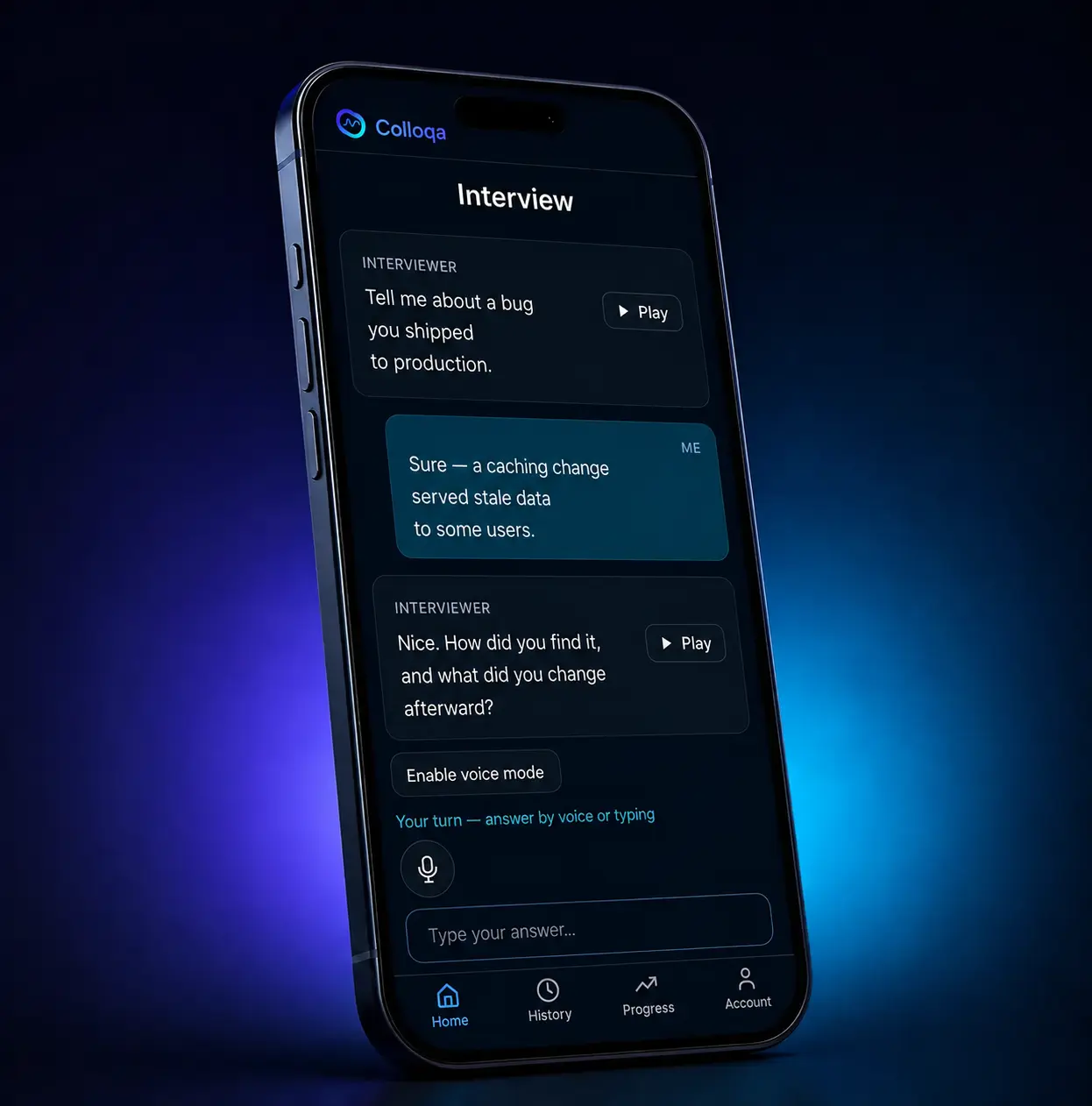
Junior dev to tech lead — rehearse the exact role you’re applying for
Backend, frontend, data, or IT support: people rehearse the real interview they’re walking into — the behavioral and technical-discussion questions a tech hiring panel actually asks.
- Software Engineer
- Software Developer
- Frontend Developer
- Backend Developer
- Full Stack Developer
- Data Analyst
- Data Scientist
- Data Engineer
- QA Engineer
- DevOps Engineer
- IT Support Specialist
- Help Desk Technician
- Systems Administrator
- Product Manager
- Engineering Manager
- Tech Lead
Built for the days before the interview
Three situations Colloqa is made for. If one sounds like this week — start there.

You can write the code but explaining your project out loud falls apart
You know the system inside out — but "walk me through it" turns into a ten-minute ramble with no shape. Practice telling it as a story: the problem, the trade-off, what you’d do differently — in under two minutes, with follow-ups.
You’ve drilled algorithms and skipped the behavioral round
Conflict with a teammate, a deadline you missed, a decision you got wrong — the behavioral interview questions for software engineers are predictable, and they decide close calls. Rehearse them, hear where your answer wandered, and tighten it.

You’re a data analyst, IT support, or switching into tech
Data analyst and IT support interviews are mostly talk-throughs: how you’d investigate a broken dashboard, handle a frustrated user, prioritise tickets. Rehearse the format you’re actually walking into — set your role and the questions follow it.
What makes the rehearsal worth 15 minutes
Six things that turn talking-to-a-bot into real prep for the conversation rounds of a tech interview.
An interviewer that actually follows up
Senior engineers dig into the details. Colloqa does too — "What trade-offs did you weigh, and how did you measure success?" — so you practice defending decisions, not reciting a project summary.
Practice out loud — voice mode
Remote screens and panel loops are judged on how clearly you think out loud. Rehearse explaining architecture and decisions in real time, not just in your head.
Behavioral, technical, or mixed
Pick the format your interview runs — behavioral rounds, a technical discussion of your projects and system design, or a realistic blend. Not a coding-puzzle bank: the conversation rounds.
Coaching feedback, not a transcript
After each session: what showed engineering judgment, what to tighten, and how to structure it — ownership, impact, trade-offs, and communication.
Drill the one thing you fumbled
Rambled through "tell me about a bug you shipped"? One tap turns it into a short, focused drill so you have a crisp version before the loop.
Watch your readiness trend up
Re-run the questions and watch your readiness climb across attempts. Built for the week before the on-site — not a one-shot demo.
Walk into the loop feeling like you’ve explained this project twice already — because you have.
Practice freeWhat a rehearsal actually looks like
A real opening question, your answer, an honest follow-up — then written coaching at the end.
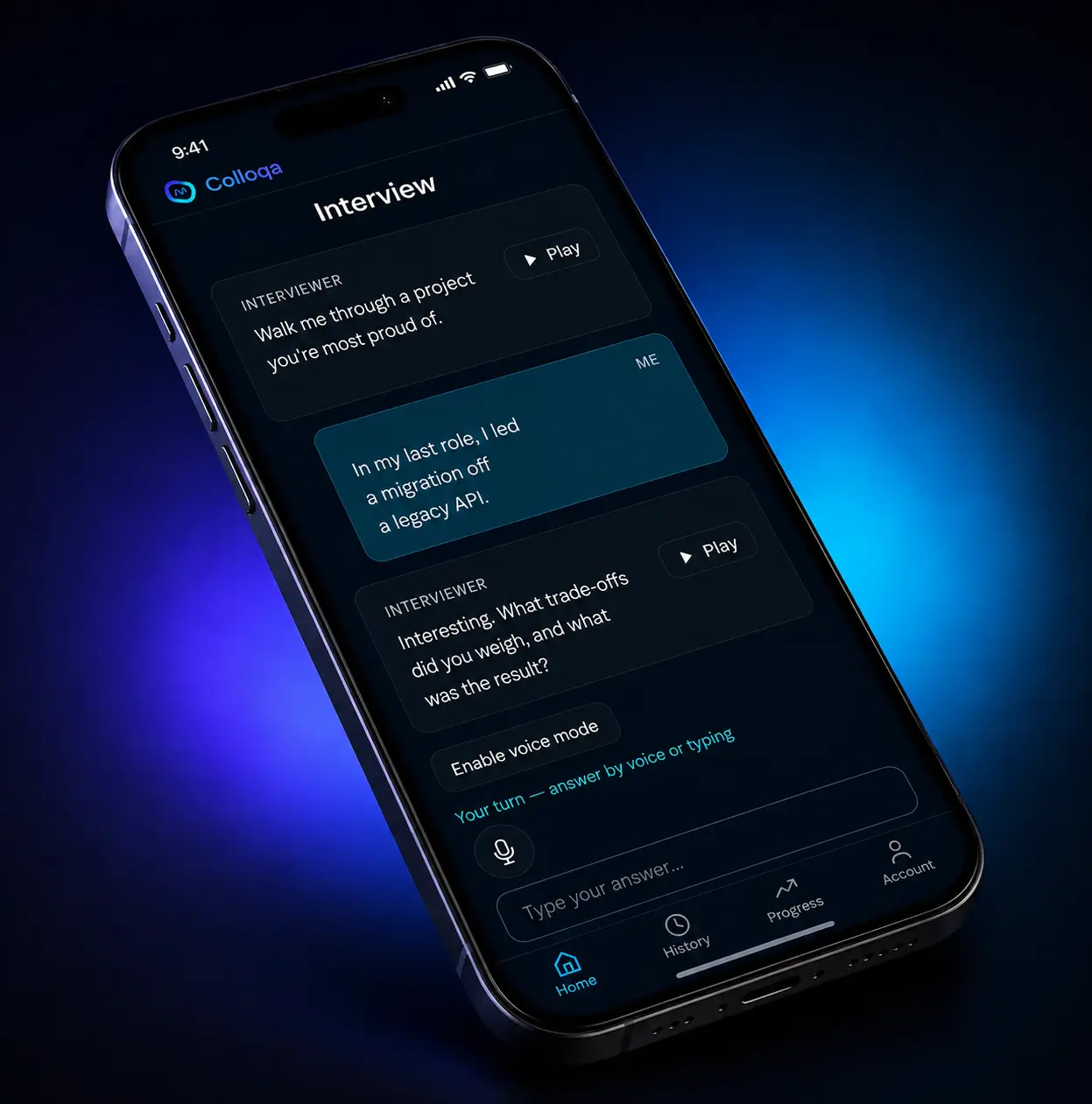
Looks useful? Run a session yourself — your transcript and feedback work the same way.
Run your first interviewHow it works
Four steps. The whole loop fits in 10 minutes.
Pick your scenario
Job interview, negotiation, hard personal talk, or the hiring manager’s seat — choose what you need to rehearse today.
Set the context in 60 seconds
A short quick-setup quiz captures who you are, what you want, who you’re talking to. The AI uses this to play the other side in character.
Practice out loud — or by typing
Voice mode in 7 languages with natural TTS / STT. The AI pushes back, probes, holds positions — like a real counterpart, not a static chatbot.
Get coaching feedback
Strengths, growth areas, and tactics to try next time. One-click "Drill this" to rehearse a specific weakness in a focused 5-8-turn session.
That's the whole loop. First session takes less than a minute to set up.
Start practicing freeQuestions software engineers & tech applicants ask us
The objections we hear most. Missing one? Email support.colloqa@gmail.com.
Yes — the behavioral and technical-discussion questions a tech hiring panel actually asks: "Walk me through a recent project", "Tell me about a difficult technical decision", "Describe a bug you shipped and what you changed", "How do you handle disagreement in code review" — plus role-specific ones for frontend, backend, data, and IT support. Set your role, level, and stack in the quick setup and the follow-ups track your answers.
No, and that’s deliberate. Plenty of tools drill algorithms; almost none rehearse the rounds that decide close calls — the project deep-dive, the behavioral loop, the system talk-through. Colloqa is the conversation half of the interview. Pair it with your usual coding practice for the whiteboard half.
Verbal ones — yes. Describe a system you built or would build and it probes the way a senior engineer does: why that database, what breaks at 10× load, what you’d change now. It won’t compile code or check a diagram, but it’s excellent at pressure-testing how you reason and explain.
Yes. Data analyst interviews are mostly talk-throughs — how you’d investigate a metric drop, explain findings to a non-technical stakeholder, a time your analysis changed a decision. IT support and help desk interviews lean on a frustrated-user scenario and ticket prioritisation. Set the role and the questions follow it.
An interviewer persona that pushes on trade-offs instead of agreeing with you, voice mode so you practice thinking out loud the way a remote screen demands, and structured coaching at the end — strengths, growth areas, drill targets — instead of a transcript.
The free tier is a full AI mock interview once a day — no credit card. With an interview loop coming up, back-to-back mock interviews, drills and the detailed feedback come with a subscription: $8.99/week or $19.99/month, cancel anytime, 7-day money-back guarantee.
No more questions? One short rehearsal beats an hour of reading interview tips.
Try Colloqa freeThe conversation isn't going away.
Better to have it twice — with the AI first.
Free to start. One minute to set up. No prep required.
Start practicing free