




Practice interviewing candidates until you spot real signal.
Switch seats. You ask the questions; an AI candidate answers with a real background and a few weak spots it won't volunteer. Learn which questions get polished answers — and which ones get the truth.
No credit card · Voice or text · 7 languages
Built for the other side of the interview table
Three people who run interviews and would rather not learn on a real candidate. If one of them is you — start there.
You’re about to run your first interviews as a manager
You know what the job needs — you’ve just never sat on this side of the table. Rehearse the arc of an interview once or twice: the opener, the follow-ups, the part where you sell the role. Make your first real candidate your third interview, not your first.
You’re a founder or team lead making key hires
Every candidate sounds great for twenty minutes. Practise the questions that get past the rehearsed story — what did YOU do, what was the number, what would you do differently — until they come out naturally, not as an interrogation.
You interview often and want sharper signal
Recruiters and seasoned managers: see which of the candidate’s weak spots your questions actually reach — and, if you like, build the candidate from a real job description or CV. The feedback shows the ones that stayed hidden — and the questions that would have found them.
What makes the rehearsal worth the time
Six things that turn a chat with a bot into real interviewer practice.
A candidate with something to hide
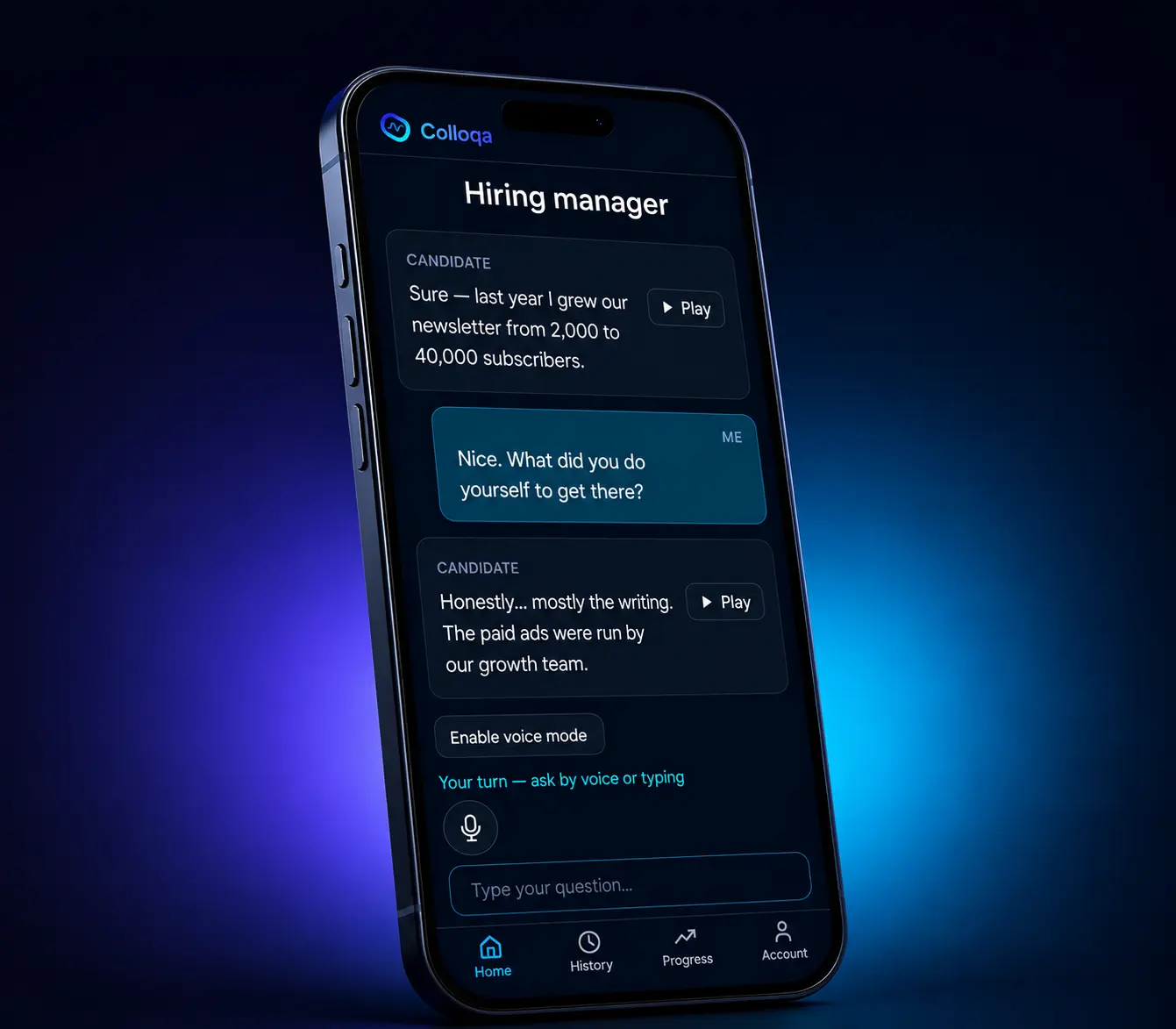
The AI builds a candidate for your opening — a real background, real strengths and two or three weak spots it won’t volunteer. Vague questions get polished answers; the right follow-up gets the truth.
Optional: a real job description or CV
Skip it and the AI builds a candidate from a few quick answers. Or paste a job description (text, link or file) and the candidate applied to exactly that role — add a CV and the AI becomes that person.
You open, like in a real interview
The candidate waits for you. A short hint suggests greeting them and starting with an easy ice-breaker — then the pace, the order and the follow-ups are yours.
Interview out loud — voice mode
Asking a sharp follow-up in your head is easy. Asking it out loud, without leading the witness, is the skill. The candidate answers in its own voice, in 7 languages.
Feedback on YOUR interviewing
A rating, what you did well, and what to work on — plus coverage (which hidden weak spots your questions surfaced) and your weak questions, quoted, each with a better version.
Drill the habit you keep repeating
Leading questions? Stacking three asks into one? One tap turns that habit into a short drill where the candidate punishes it — until the better question comes first.
Interview one candidate tonight — the real one tomorrow gets a better interviewer.
Practice freeWhat a rehearsal actually looks like
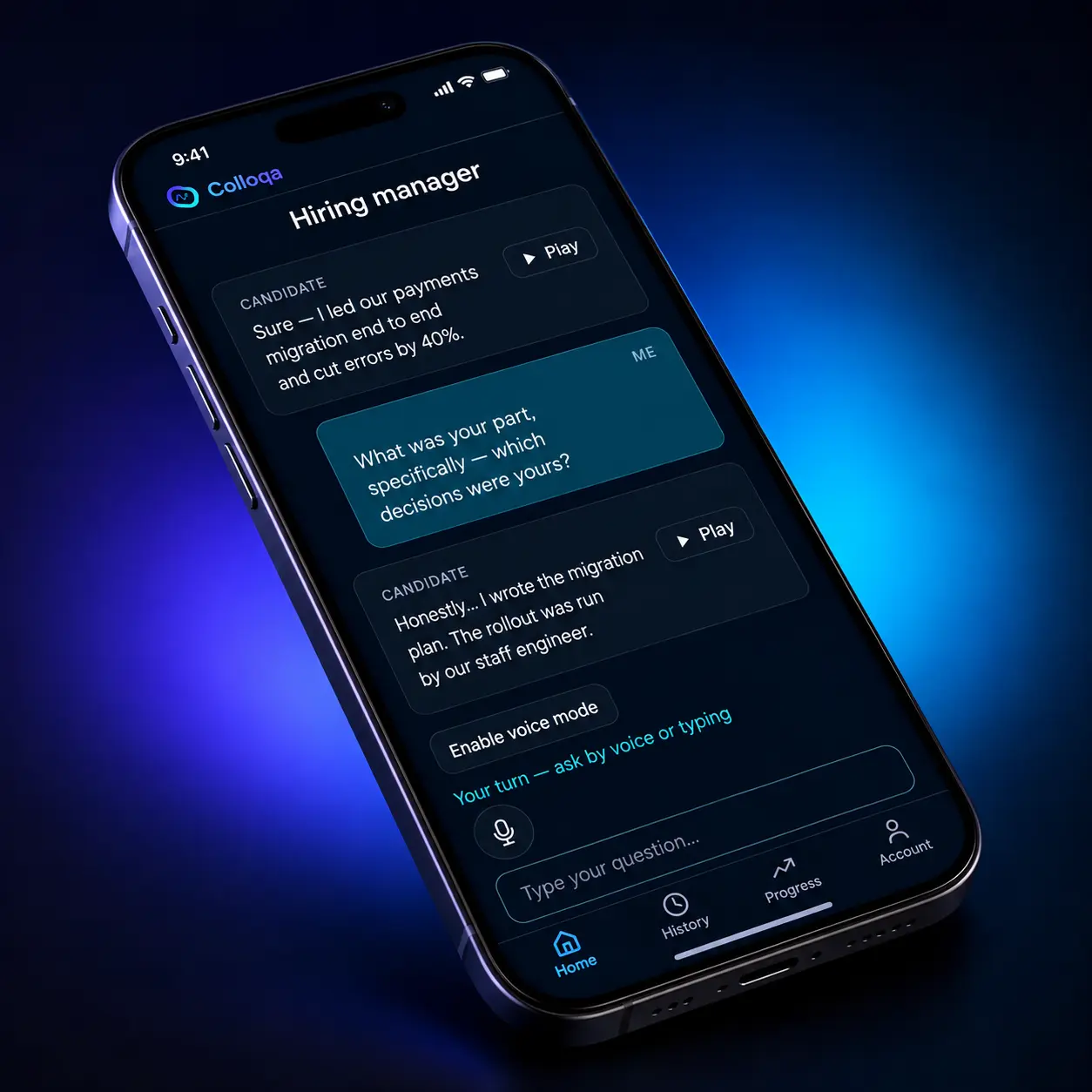
A polished answer, one specific follow-up — and the part of the story the candidate wasn't going to tell you.
Looks useful? Set up your opening in under a minute and meet your first candidate.
Run your first interviewHow it works
Four steps. The whole loop fits in 10 minutes.
Pick your scenario
Job interview, negotiation, hard personal talk, or the hiring manager’s seat — choose what you need to rehearse today.
Set the context in 60 seconds
A short quick-setup quiz captures who you are, what you want, who you’re talking to. The AI uses this to play the other side in character.
Practice out loud — or by typing
Voice mode in 7 languages with natural TTS / STT. The AI pushes back, probes, holds positions — like a real counterpart, not a static chatbot.
Get coaching feedback
Strengths, growth areas, and tactics to try next time. One-click "Drill this" to rehearse a specific weakness in a focused 5-8-turn session.
That's the whole loop. First session takes less than a minute to set up.
Start practicing freeQuestions people about to interview ask us
The ones we hear most. Missing one? Email support.colloqa@gmail.com.
Anyone who has to run an interview and has done it rarely or never: first-time hiring managers, team leads hiring for their own team, founders making the first hires, and recruiters who want sharper follow-up questions. You sit in the interviewer’s chair; the AI is the candidate.
Before its first answer the AI builds a candidate for your opening — a background, real strengths and two or three hidden weaknesses it will not volunteer. It answers the question you actually asked: a vague question gets a polished, vague answer; a specific follow-up ("what exactly did you do?", "what was the number?") gets the honest one. A leading question gets agreement, just like with real candidates.
Yes, both are optional steps in the setup. Paste the job description, drop a link to it, or upload a PDF / DOCX — the candidate will have applied to exactly that role. Paste or upload a CV and the AI plays that person: it answers from the CV, never contradicts it, and hides its weak spots inside the claims on it, so probing the CV is how you find them.
You do — like in a real interview. When the session starts, a short hint suggests greeting the candidate and opening with an easy ice-breaker before the first real question. After that the pace is yours.
A rating of your interviewing (Strong interviewer, Getting there, or Needs work), what you did well, and what to work on. Plus two things you only get from a simulated candidate: coverage — which of the candidate’s hidden weaknesses and strengths your questions actually surfaced — and flagged questions, quoted from your transcript (leading, closed, stacked, inappropriate or off-target) with a better version of each.
Yes. Ask about age, family plans, religion, health or nationality and the candidate reacts the way a real one would — politely uncomfortable, steering back to the job — and the feedback flags the question and suggests what to ask instead.
That’s what Drill mode is for. After a session, tap "Drill this" on a growth area and you get a short interview where the candidate is tuned to punish exactly that habit — leading questions get agreement, shallow questions get shallow answers — until the better habit sticks. Drills are part of the subscription.
The free tier is one full session a day with up to 45 minutes of voice — no credit card required. A subscription is $8.99/week or $19.99/month, cancel anytime, with a 7-day money-back guarantee — it unlocks unlimited sessions, drills and the detailed feedback.
Yes. Speak or type, in 7 languages — English, Українська, Polski, Español, Português, Deutsch and Français. The candidate answers out loud in its own voice, and you can switch language mid-conversation.
No more questions? One practice interview teaches more than a list of interview questions.
Try Colloqa freeThe conversation isn't going away.
Better to have it twice — with the AI first.
Free to start. One minute to set up. No prep required.
Start practicing free