




Investor pitch practice — rehearse the meeting, not just the slides.
Nobody loses a round on slide seven. They lose it in the questions: “why hasn’t anyone done this?”, “what’s your CAC?”, “that valuation is high for this stage”. Rehearse the pitch out loud with an AI investor or partner that interrupts, doubts your numbers and pushes on terms — and hear afterwards where you rambled, hedged or conceded too early.
No credit card · Voice or text · 7 languages · Your numbers stay private
12 founder meetings worth rehearsing out loud
Pick the meeting on your calendar and run it until the answer to the question you dread comes out in two sentences.
- First call with a VC
- Partner meeting at a fund
- Angel investor coffee
- “Why now, why you?”
- “What’s your CAC and payback?”
- Valuation pushback
- Term sheet: board seat, pro rata
- Pitching an accelerator or venture builder
- Partnership with a larger company
- Pilot and revenue-share terms
- Asking a corporate for resources
- Bridge round from existing investors
How to pitch to investors — 6 steps for the meeting
The deck gets you the meeting; this is how the meeting itself goes well. The same structure works for a partner company. It is what the feedback scores you against — most founders lose ground at step 3 (a long answer to a short question) or step 5 (negotiating against themselves on valuation).
Open with the one sentence they will repeat
What you do, for whom, and the proof — in one breath: “We cut invoice reconciliation for mid-size logistics firms from four days to four hours; 23 paying customers, 18% month-on-month.” Whatever they repeat to their partners on Monday starts here.
Know your ask before you walk in
How much, on what terms, for what milestones — and your alternative if this one says no (another lead, more runway, revenue). For a partner: exactly what you want from them and what they get. Without a walk-away you will negotiate against yourself.
Answer the question, then stop
Two or three sentences with a number, not a two-minute story. “CAC is 1,400 dollars, payback eleven months, falling since we moved to outbound.” If they want more, they will ask — and a crisp answer is the signal they are really testing for.
Meet the hard question head-on
“Why hasn’t Google done this?” “What if the customer builds it in-house?” Acknowledge the risk in one line, then say what you know that they don’t. Getting defensive costs more than the risk itself.
On valuation and terms, anchor and trade
State your terms with one reason and hold them for one round of pushback. If something has to move, trade it: a lower valuation for a smaller dilution, a board seat for a founder-friendly vote, a pilot for a paid pilot with a conversion date. Never concede in the same breath as the objection.
Close on a next step with a date
“What would you need to see to move to a partner meeting?” or “Can we agree the pilot scope by Friday?” A meeting that ends with “let’s keep in touch” is a no that hasn’t been said yet.
Lines founders rehearse here
- “Why hasn’t anyone done this before?”
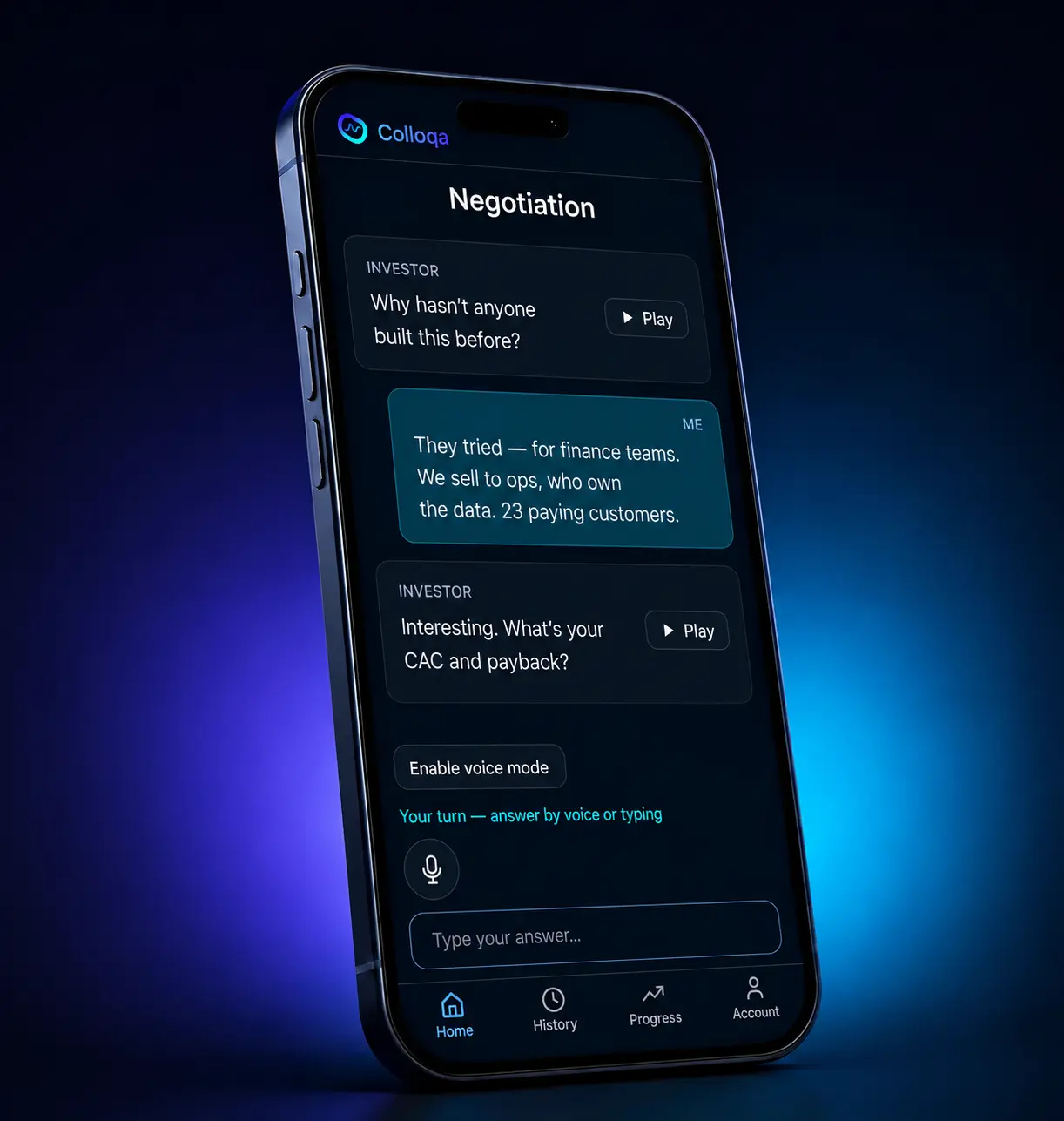
“They tried — with a tool for the finance team. We sell to operations, who own the data, and that is why our onboarding takes a day instead of a quarter.”
- Valuation pushback
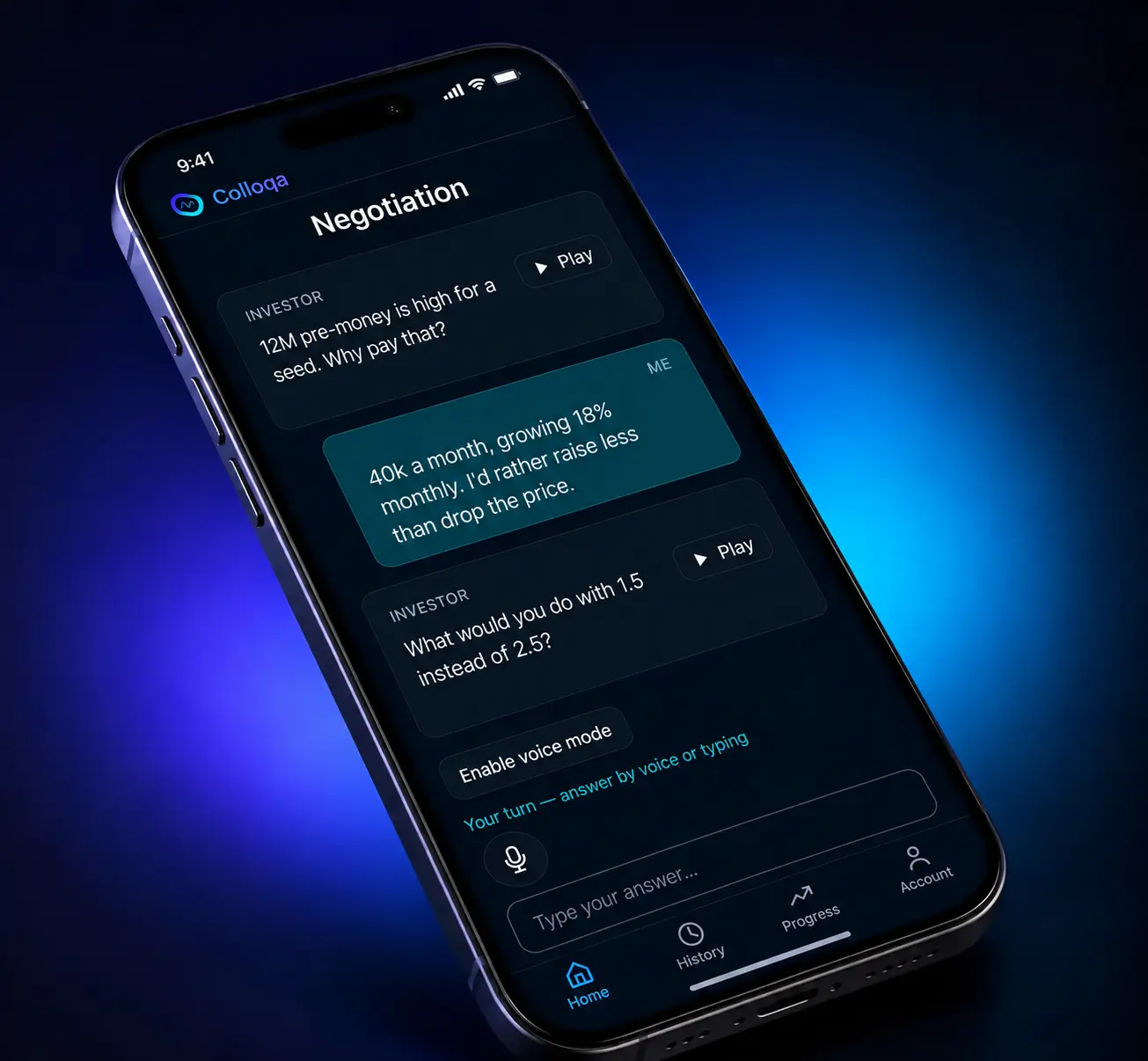
“I hear that it’s high for a seed. It reflects 40k of monthly revenue growing 18% a month — if the number is the blocker, I’d rather talk about the size of the round than a lower price.”
- A partner company asks for exclusivity
“Exclusivity is on the table for twelve months in your vertical — tied to a signed volume commitment. What volume could you commit to?”
- Closing the meeting
“What would you need to see from us to take this to your partners? If it’s the cohort data, I can send it by Thursday.”
Built for the meeting you can’t afford to rehearse on the real person
Three founders who use this most. If one of them is you — run the meeting tonight, with your real numbers.
First round, first VC calls
You have ten calls booked and one shot at each. Rehearse the opening, the metrics questions and “why you?” until the answers are short — so the first real call isn’t your practice run.
A partnership with a much bigger company
Their CTO has the resources, you have the product. Practise asking for access, a pilot or revenue share without giving away exclusivity or your roadmap in the first meeting.
A term sheet on the table
The valuation is lower than you hoped and there’s a board seat in it. Rehearse the counter, what you will trade and what you won’t — before the call with the partner who wrote it.
What makes this better than pitching to your co-founder
Six things that turn “we should practise the pitch” into a meeting you have already had once.
An investor that actually pushes back
Not a polite audience. The AI investor or partner interrupts, doubts your numbers, asks “why now?” and leans on valuation — the way a real partner meeting goes, until your answer earns the next question.
Your real company, round and terms
Enter what you do, your traction, the round or deal you want, who you are meeting and your alternative if it falls through. The AI argues from inside that — and your numbers stay in your account.
Say it out loud — voice mode
A pitch that reads well can still sound rehearsed or rambling. Voice mode catches pace, filler and the long pause before “our CAC is…”. 7 languages, if the meeting isn’t in your first one.
Feedback on answers and on the ask
Did you answer the question or talk around it? Hold your terms or concede on the first objection? The read names the moments and the likely outcome — not a vague “be more confident”.
Drill the question you dread
Fumble “what’s your moat?” every time? One tap turns that moment into a short, focused drill you can repeat until the answer is two sentences long.
Private to your account
Your metrics, your cap table and the name of the fund stay with you. No training on your sessions, no sharing, voice isn’t stored.
Hear the hard question before it counts.
Practice freeWhat a rehearsed investor meeting looks like
The investor tests your numbers and your price, you hold the line and trade — then a short read on what landed and what you gave away.
Looks useful? Run it with your real round — none of it leaves your account.
Start your first rehearsalHow it works
Four steps. The whole loop fits in 10 minutes.
Pick your scenario
Job interview, negotiation, hard personal talk, or the hiring manager’s seat — choose what you need to rehearse today.
Set the context in 60 seconds
A short quick-setup quiz captures who you are, what you want, who you’re talking to. The AI uses this to play the other side in character.
Practice out loud — or by typing
Voice mode in 7 languages with natural TTS / STT. The AI pushes back, probes, holds positions — like a real counterpart, not a static chatbot.
Get coaching feedback
Strengths, growth areas, and tactics to try next time. One-click "Drill this" to rehearse a specific weakness in a focused 5-8-turn session.
That's the whole loop. First session takes less than a minute to set up.
Start practicing freeQuestions founders ask before an investor meeting
The things we hear most. Missing one? Email support.colloqa@gmail.com.
Colloqa’s investor pitch practice is an AI role-play for the meeting after the deck: you describe your company, the round or deal you want, who you are meeting and what they care about, then pitch out loud to an AI investor, VC partner or corporate partner that asks the hard questions and pushes back on valuation and terms — and get feedback on how clearly you answered, how firmly you held your ask and what you gave away.
Out loud, to someone who interrupts. Reading the deck to yourself tests the slides, not the meeting — the round is won or lost in the questions. In Colloqa you set up your company, round and the investor you are meeting, pitch by voice, and the AI investor asks the hard questions and pushes on valuation. Run it a few times until your answers to the questions you dread are two sentences long.
Almost always: why this problem and why now, why your team, how big the market really is, what your traction and unit economics are (CAC, payback, retention), who else is doing this and what stops a bigger company, how much you are raising and what it buys, and why this valuation. Prepare a short answer with a number for each — and rehearse saying them, not just writing them.
Give one reason for your number — usually traction or growth — and hold it for one round of pushback. If something has to move, trade instead of discounting: a smaller round rather than a lower price, a lower valuation for better terms, a milestone that unlocks a second tranche. The mistake the feedback flags most often is lowering the number in the same breath as the objection.
Yes. Set the other side as a partner company — a CTO, a head of partnerships, a corporate innovation team — and describe what you want (a pilot, access to their customers or infrastructure, revenue share) and what they want from you. The AI negotiates as them, including the asks founders often concede too early: exclusivity, IP, a free pilot.
You describe them in setup — your company, traction, the round or deal, who you are meeting and what they care about, and your alternative if it falls through. The AI plays that investor or partner in character. Everything stays private to your account and is not used for training.
Yes — voice and text in English, Ukrainian, Polish, Spanish, Portuguese, German and French, and you can switch language mid-conversation. Useful when you are pitching a fund or partner in your second language.
The free tier is one full rehearsal a day with voice — no credit card. If you want to run the same conversation several times in one evening, drill the one move you keep missing and get the detailed feedback, that comes with a subscription: $8.99/week or $19.99/month, cancel anytime, 7-day money-back guarantee.
No more questions? Try it with the conversation that’s actually on your mind.
Try Colloqa freeThe conversation isn't going away.
Better to have it twice — with the AI first.
Free to start. One minute to set up. No prep required.
Start practicing free