




Rehearse your sales interview until you handle every objection without flinching.
An AI interviewer that role-plays the hiring manager and the buyer — "sell me this pen", a deal you lost, walking through your numbers, a churn-risk call — and pushes back like a real one. Get coaching feedback and sharpen your pitch before the interview.
No long forms. Set your role, start rehearsing in 60 seconds.
12 languages · Real follow-up questions · Practice out loud
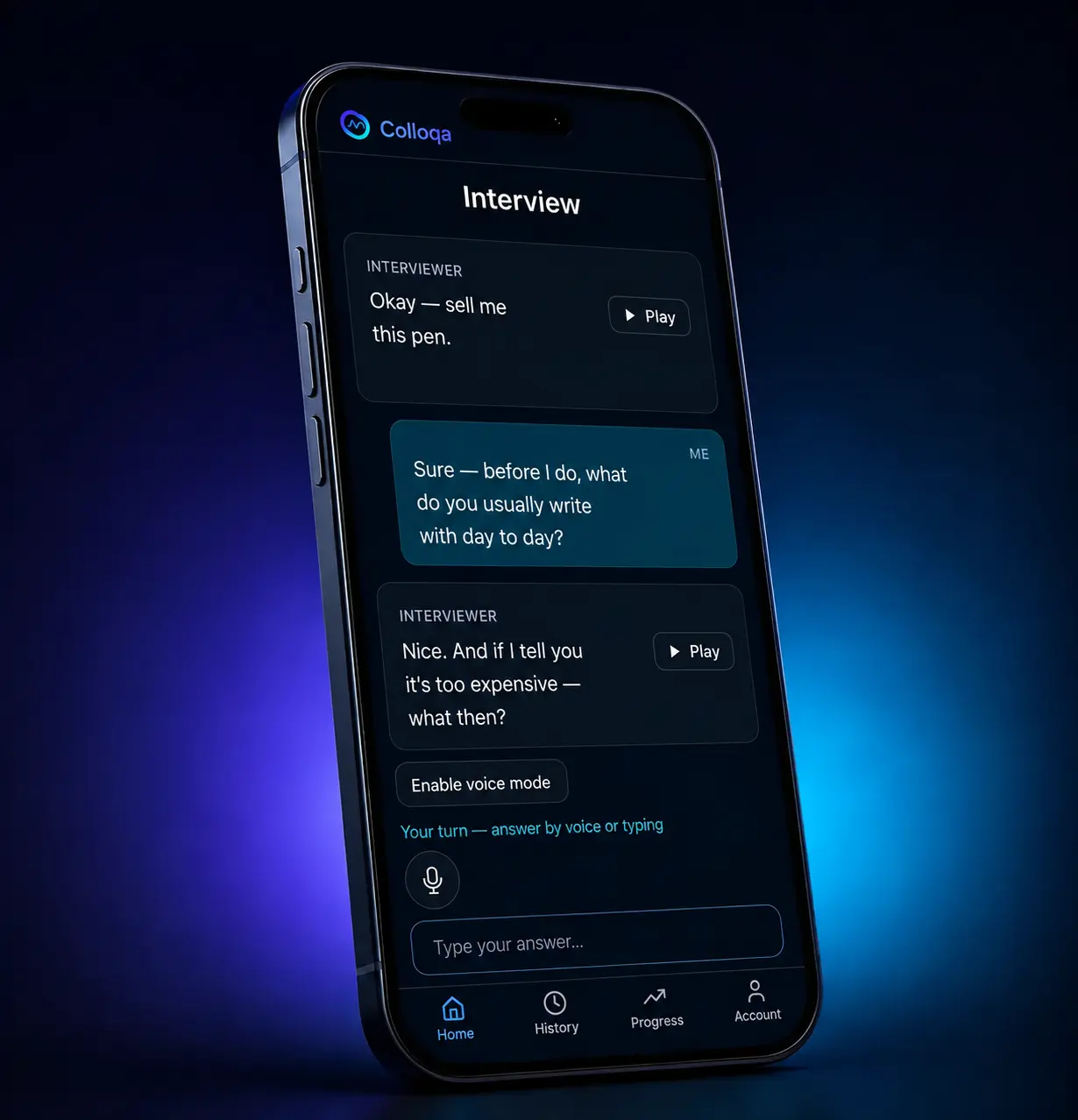
SDR to account executive — rehearse the exact role you’re applying for
Retail floor to enterprise quota: people rehearse the real interview they’re walking into — the role-plays, objection handling, and "walk me through your numbers" questions a sales leader actually asks.
- Sales Development Rep (SDR)
- Business Development Rep (BDR)
- Account Executive
- Sales Representative
- Sales Associate
- Inside Sales Rep
- Account Manager
- Customer Success Manager
- Leasing Consultant
- Real Estate Agent
- Insurance Sales Agent
- Home Improvement Sales Rep
- Retail Sales Consultant
- Appointment Setter
- Sales Team Lead
- Sales Manager
16 sales interview questions (and what a strong answer sounds like)
These are the questions a sales manager actually asks — in SDR, account executive, and customer success interviews — and the ones Colloqa’s AI interviewer will ask you, with follow-ups and pushback, until the answers sound like you’ve sold before.
Tell me about yourself.
Treat it as your first pitch: who you sell to now (or the customer-facing work you’ve done), one result with a number, and why this role. Under ninety seconds — the manager is judging how you’d sound on a first call.
Why sales?
Skip “I’m a people person” and “the money”. Say what you actually enjoy — the competition, the conversations, solving a buyer’s problem — and point to a moment you did it.
Tell me about a deal you’re proud of closing.
Walk through the deal, not just its size: how it started, the moment it nearly died, what you did to move it forward. Include the number, and be clear which part was yours and which was the team’s.
How do you handle rejection?
Show a routine, not a mood: what you do after a bad call, how you pull the lesson out of it, how you keep the next dial fresh. A real run of no’s you came back from is the best evidence.
Walk me through how you run a discovery call.
Your structure, out loud: the research before the call, the questions you open with, how you find the real problem and who makes the decision. They’re listening for whether you ask before you pitch.
How do you keep a deal moving when the buyer goes quiet?
Give your actual sequence — a follow-up with something useful in it, a second contact, an honest “should I close this out?” — and when you let it go. Chasing forever reads as poor pipeline judgment.
How do you build the relationship with a customer after the sale?
For account management and customer success, the job starts at signature. Describe your cadence — onboarding, regular check-ins, spotting risk early — and one account you grew or kept because of it.
How do you organise your day and your pipeline?
Name the system: the CRM, the time blocks you protect for prospecting, how you decide which deals get attention today. Disorganised reps lose deals, so a concrete routine is the answer.
Tell me about a time you missed your target.
Don’t hide it. The number, the honest reason (pipeline, territory, your own focus), what you changed, and what happened the next quarter. Owning a miss is more convincing than a spotless record.
Sell me this pen.
The trap is to start describing the pen. Ask two questions first — when they last used one, what for — then sell to that answer and ask for the order. The manager is checking whether you discover before you pitch and whether you close at all.
Tell me about a deal you lost. What would you do differently?
A real loss with a real reason: you didn’t reach the decision-maker, you discounted too early, you never found the actual pain. Say what you changed in the next deal because of it. A loss you learned from is worth more than a win you can’t explain.
A prospect says it’s too expensive. What do you say?
Don’t reach for the discount. Ask “compared to what?”, find out what the price is being weighed against, and go back to the cost of the problem you uncovered in discovery. Give the line you actually use and a time it worked — and a time you walked away.
How do you prospect and build a pipeline from nothing?
Your real routine: how you pick accounts, the mix of calls, email and LinkedIn, how many touches before you stop, and the numbers — activity per day, meetings per week — that routine produces. Vague “I’m persistent” loses to a rep who knows their conversion rates.
Walk me through your numbers — quota, attainment, average deal size, cycle length.
Have them ready and be exact, including the quarter you missed. Explain one number: why the cycle is that long, what moved attainment up. Managers can tell a rep who tracks their own numbers from one who repeats a resume line.
It’s the last week of the quarter and you’re behind. What do you do?
Name the moves in order — the deals that can actually close, the ask you make of each buyer, what you offer and what you refuse to offer — and what you do on the Monday after, whether you made it or not. Panic-discounting everything is the answer they don’t want to hear.
Do you have any questions for us?
In sales this is part of the test — treat it like discovery. Ask how targets are set, what separates the top reps, and what ramp-up looks like for a new hire. Then ask about the next step, the way you would with a buyer.
Reading them is not the same as answering them out loud while a buyer pushes back.
Rehearse these out loudBuilt for the days before the interview
Three situations Colloqa is made for. If one sounds like this week — start there.

You know a role-play is coming and you don’t want your first attempt to be in the room
"Sell me this pen", a cold-call simulation, a buyer who says it’s too expensive — the role-play is where sales interviews are won or lost. Run it three times tonight against an AI buyer that objects, and walk in with a pitch you’ve already tested.
Your results are good but you stumble when asked to talk about them
Quota attainment, a deal you lost and why, how you prospect, your pipeline process — the questions are predictable. Practice telling them with numbers, get told where you rambled, and tighten each story to a minute.

You’re new to sales or moving into customer success
First SDR role, retail associate to inside sales, or sales into customer success — the interview shifts from closing to retention, onboarding, and churn conversations. Rehearse the format you’re actually walking into.
What makes the rehearsal worth 15 minutes
Six things that turn talking-to-a-bot into real prep for a sales or customer success interview.
An interviewer that actually follows up
Sales leaders push back on purpose. Colloqa does too — "That’s still too expensive — what now?" — so you practice handling the objection live instead of describing how you would.
Practice out loud — voice mode
Sales is judged on how you sound: confidence, pace, energy. Rehearse your pitch and your stories out loud — the closest thing to the phone screen or role-play round.
Role-play, behavioral, or mixed
Pick the format your interview runs — a live buyer role-play, "tell me about a deal you lost", or a realistic blend. SDR and customer success are very different interviews.
Coaching feedback, not a transcript
After each session: what landed, what to fix, and how to say it — discovery questions, objection handling, your numbers, and closing with a clear next step.
Drill the one thing you fumbled
Lost the thread on "why did you miss quota that quarter"? One tap turns it into a short, focused drill so you have a crisp, honest version before the interview.
Watch your readiness trend up
Re-run the role-play and watch your readiness climb across attempts. Built for the days before the interview — not a one-shot demo.
Walk into the interview feeling like you’ve pitched this twice already — because you have.
Practice freeWhat a rehearsal actually looks like
A real opening question, your answer, an honest follow-up — then written coaching at the end.
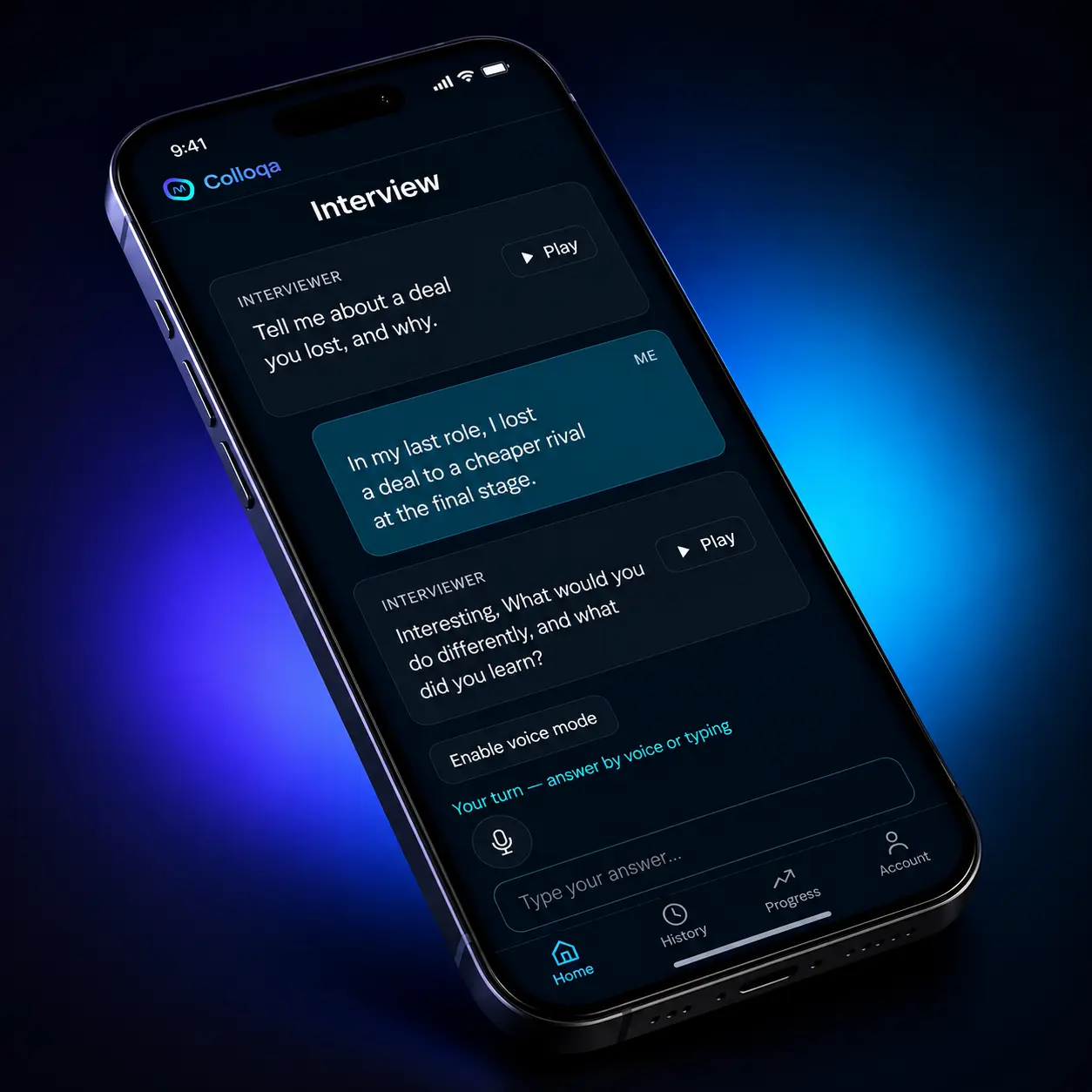
Looks useful? Run a session yourself — your transcript and feedback work the same way.
Run your first interviewWatch a full medical sales mock interview
Five real questions for a sales rep role at a hospital system, the answers and the score at the end. Setup is sped up and marked on screen; the candidate’s answers are re-voiced with AI from the app’s own transcript.
How it works
Four steps. The whole loop fits in 10 minutes.
Pick your scenario
Job interview, negotiation, hard personal talk, or the hiring manager’s seat — choose what you need to rehearse today.
Set the context in 60 seconds
A short quick-setup quiz captures who you are, what you want, who you’re talking to. The AI uses this to play the other side in character.
Practice out loud — or by typing
Voice mode in 12 languages with natural TTS / STT. The AI pushes back, probes, holds positions — like a real counterpart, not a static chatbot.
Get coaching feedback
Strengths, growth areas, and tactics to try next time. One-click "Drill this" to rehearse a specific weakness in a focused 5-8-turn session.
That's the whole loop. First session takes less than a minute to set up.
Start practicing freeQuestions sales & customer success applicants ask us
The objections we hear most. Missing one? Email support.colloqa@gmail.com.
The ones a sales manager actually asks: "Sell me this pen", "Walk me through your numbers", "Tell me about a deal you lost", "How do you handle a prospect who says it’s too expensive", "How do you prospect" — plus customer success versions: a churn-risk account, an onboarding gone wrong, an upsell conversation. Set your role and level in the quick setup and the AI tailors the questions and follow-ups.
Yes, that’s its strongest use. Tell it the product or paste the job post, pick the role-play format, and it plays the buyer — hesitant, price-sensitive, short on time — and objects the way a real one would. Then it coaches you on discovery, objection handling, and how you closed.
Yes. Those interviews lean on retention scenarios — a customer threatening to churn, a renewal at risk, an onboarding that went sideways — plus "how do you measure customer health". Set customer success manager or account manager as the role and the questions follow it.
That’s exactly who gets the most out of it. Entry-level sales interviews test coachability, resilience, and whether you can hold a conversation under pressure — not a track record. Running the questions two or three times makes them feel routine, so the real one feels like something you’ve already done.
A buyer persona that objects instead of agreeing with you, voice mode so you actually practice pitching out loud with energy, and structured coaching at the end — strengths, growth areas, drill targets — instead of a transcript.
The free tier is a full AI mock interview once a day — no credit card. With an interview coming up, back-to-back mock interviews, drills and the detailed feedback come with a one-time pass: $9.99 for 1 week, $19.99 for 1 month or $49.99 for 3 months. Nothing renews, and there is a money-back guarantee (7 days; 3 days on the 1-week pass).
No more questions? One short rehearsal beats an hour of reading interview tips.
Try Colloqa freeThe conversation isn't going away.
Better to have it twice — with the AI first.
Free to start. One minute to set up. No prep required.
Start practicing free