




Rehearse your administrative assistant interview until every answer sounds organized and in control.
An AI interviewer that role-plays the office manager — two managers with the same deadline, a confidential document on your desk, a phone line ringing while a visitor waits — and follows up like a real one. Get coaching feedback and fix your weak spots before the interview.
No long forms. Set your role, start rehearsing in 60 seconds.
12 languages · Real follow-up questions · Practice out loud
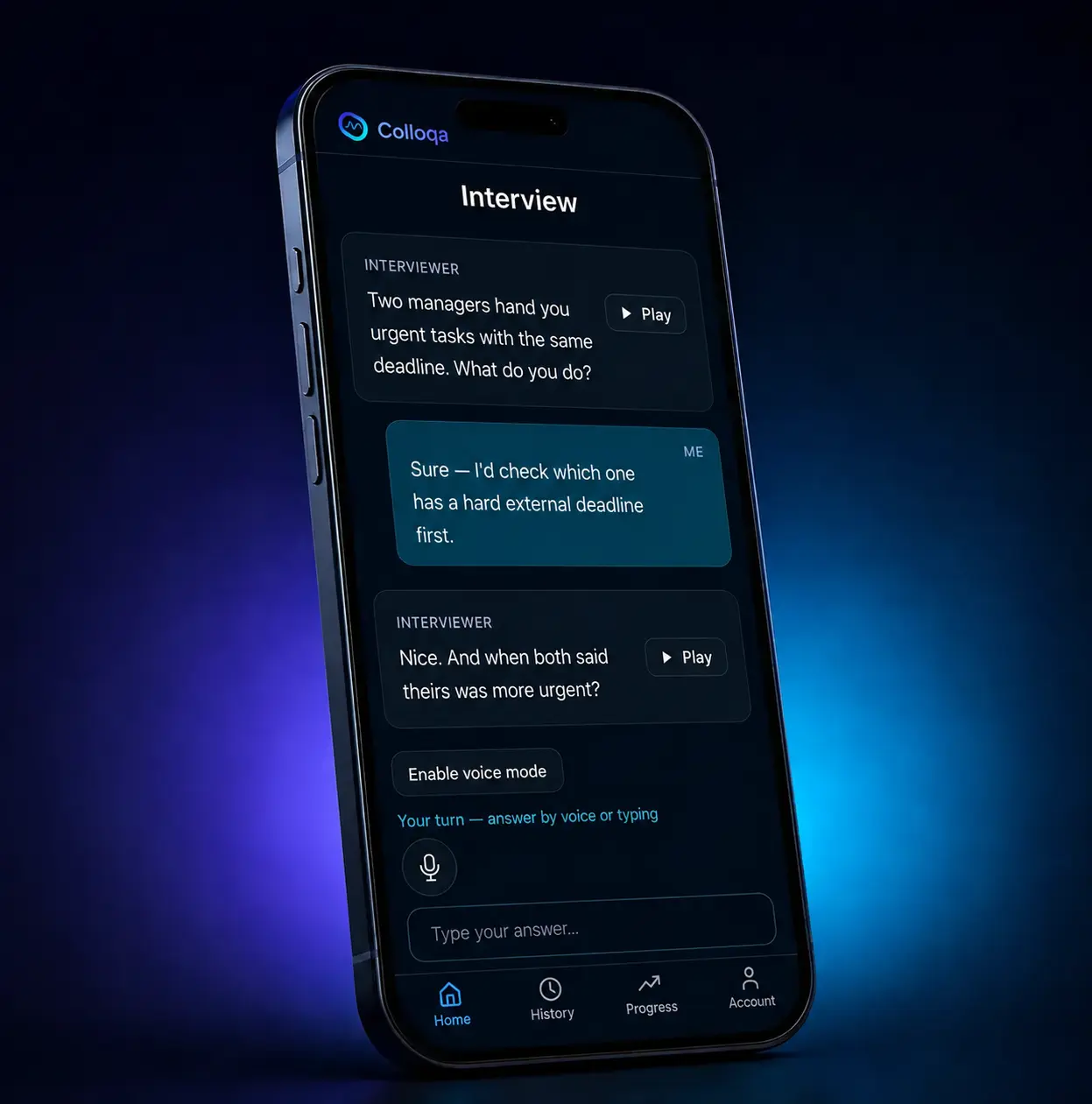
Receptionist to executive assistant — rehearse the exact role you’re applying for
Front desk, back office, or fully remote: people rehearse the real interview they’re walking into — the prioritization, confidentiality, and "which tools do you use" questions an admin employer actually asks.
- Administrative Assistant
- Executive Assistant
- Receptionist
- Front Desk Associate
- Office Assistant
- Office Administrator
- Office Manager
- Virtual Assistant
- Executive Virtual Assistant
- Healthcare Virtual Assistant
- Real Estate Virtual Assistant
- Administrative Coordinator
- Project Coordinator
- Data Entry Clerk
- Admissions Assistant
- Personal Assistant
16 administrative assistant interview questions (and what a strong answer sounds like)
These are the questions an office manager or HR actually asks — for administrative assistant, receptionist, and executive assistant roles — and the ones Colloqa’s AI interviewer will ask you, with follow-ups, until the answers sound organized.
Tell me about yourself.
Three beats: the office or people you support now, the thing colleagues rely on you for, and why this role. Keep the task list short — the interviewer is listening for how you’d come across at their front desk.
Why are you leaving your current job?
Stay forward-looking: what you want more of — responsibility, a bigger team, an executive to support — rather than what you dislike. Never criticize your current manager; admins are hired for discretion.
What are the most important skills for an administrative assistant?
Don’t just list organization and communication. Pick two or three and attach each to something you actually do — how you track requests, how you confirm a meeting — so every skill comes with proof.
Tell me about a process you improved or set up from scratch.
Pick one — a filing system, an onboarding checklist, a rule for a shared inbox. What wasn’t working, what you changed, and what it saved: fewer missed requests, less chasing, time back for the team.
Tell me about a time you anticipated a need before anyone asked.
The best assistants are a step ahead. One example: what you noticed (a clash in the calendar, a missing document, a visitor with nowhere to park), what you did, and the problem it avoided.
How do you handle a task you’ve never done before?
Show resourcefulness: look for an existing process or past example, ask one clear question rather than five, then write down what you learned so it’s faster next time.
How would you handle a coworker who keeps missing deadlines you depend on?
Show that you deal with it directly and kindly: a quick private check-in, a clear reminder of the date, and an escalation only if the pattern continues. They’re checking you won’t quietly absorb it or complain to everyone.
Describe a time you had to communicate something important to the whole office.
Pick a real one — a policy change, an office move, a system outage. How you wrote it, who you checked it with first, and how you made sure people actually read it.
Tell me about a mistake you made at work.
Pick a real one — a double-booked room, a wrong date in an invite, an email to the wrong list. What you did in the first ten minutes, who you told, and the check you use now so it doesn’t happen again.
Three people need something from you at once. How do you prioritize?
The core admin question. Give your actual rule: deadline and impact first, who is blocked, who you can give a quick time estimate to so they stop waiting. Then one real morning where you did exactly that. “I just stay calm” isn’t a method.
Which software are you confident in — Outlook, Excel, Google Workspace, Teams?
Name what you use daily and what you actually do in it: calendar rules in Outlook, the Excel functions you reach for, a mail merge, a shared drive you organized. Be honest about the gaps and say how quickly you picked up the last tool you learned.
How do you handle confidential information?
Concrete habits: what stays off your screen when someone walks past, what you never forward, how you answer when a colleague asks about a salary or a meeting they shouldn’t know about. One example of politely saying no is the answer.
Tell me about a time you dealt with a difficult caller or visitor.
What they wanted, why they were frustrated, what you said first, and how you got them to the right person or a clear next step without promising something you couldn’t deliver. Front-desk roles are judged on this answer more than any other.
How do you manage a calendar when everything is marked as a priority?
Show that you ask rather than guess: what you clarify with the executive, how you protect focus time, and how you move a meeting without creating a chain of resentments. A story where you rescued a double-booked day lands well.
Why do you want to be an administrative assistant?
Avoid “I like being organized”. Say what you enjoy about being the person an office runs through, the kind of team or executive you want to support, and where you see it going — office manager, executive assistant, operations. It shows a choice, not a fallback.
Do you have any questions for us?
Ask who you’d support day to day, what a typical week looks like, and what the last person in the role did that people still mention. It shows you’re already working out how to be useful.
Reading them is not the same as answering them out loud with an interviewer waiting.
Rehearse these out loudBuilt for the days before the interview
Three situations Colloqa is made for. If one sounds like this week — start there.
You know "how do you prioritize when everyone needs something now" is coming and "I’m very organized" won’t cut it
Competing deadlines, a mistake you caught before it shipped, a confidential file you had to handle — administrative assistant interview questions are predictable, but answering them with a real system instead of adjectives is rare. Rehearse the exact ones tonight, get told where the answer went vague, and tighten it until the interviewer can hear how you actually work.
It’s a remote virtual assistant role and the interview doubles as a communication test
How you sound on the call — clarity, pace, confidence in English — is being scored as much as your answers, and so is "how do you stay productive without anyone watching". Practice out loud, hear how you actually come across, and walk into the video interview already comfortable naming your tools and your routine.

You’re moving up — receptionist to executive assistant, admin to office manager
The questions change when you interview to run an executive’s calendar and inbox or an office on your own: gatekeeping, discretion, saying no to a director politely, keeping ten things moving without being asked. Rehearse the format you’re actually walking into.
What makes the rehearsal worth 15 minutes
Six things that turn talking-to-a-bot into real prep for an admin, reception, or assistant role.
An interviewer that actually follows up
Office managers probe the details. Colloqa does too — "And when both managers said theirs was urgent?" — so you practice showing your system on the spot instead of reciting "I’m very organized".
Practice out loud — voice mode
Admin, reception, and VA roles are judged on how you come across on the phone and at the desk. Rehearse your tone and clarity out loud — the closest thing to the phone screen you’ll actually face.
Behavioral, situational, or mixed
Pick the format your interview runs — "tell me about a time you caught an error", a two-managers-one-deadline scenario, or a realistic blend. Receptionist and executive assistant are very different interviews.
Coaching feedback, not a transcript
After each session: what landed, what to fix, and how to say it — prioritization, discretion with confidential information, attention to detail, and the tools you actually name.
Drill the one thing you fumbled
Rambled through "how do you handle confidential information"? One tap turns it into a short, focused drill so you have a crisp version before the interview.
Watch your readiness trend up
Re-run the questions and watch your readiness climb across attempts. Built for the days before the interview — not a one-shot demo.
Walk into the interview feeling like you’ve done it twice already — because you have.
Practice freeWhat a rehearsal actually looks like
A real opening question, your answer, an honest follow-up — then written coaching at the end.
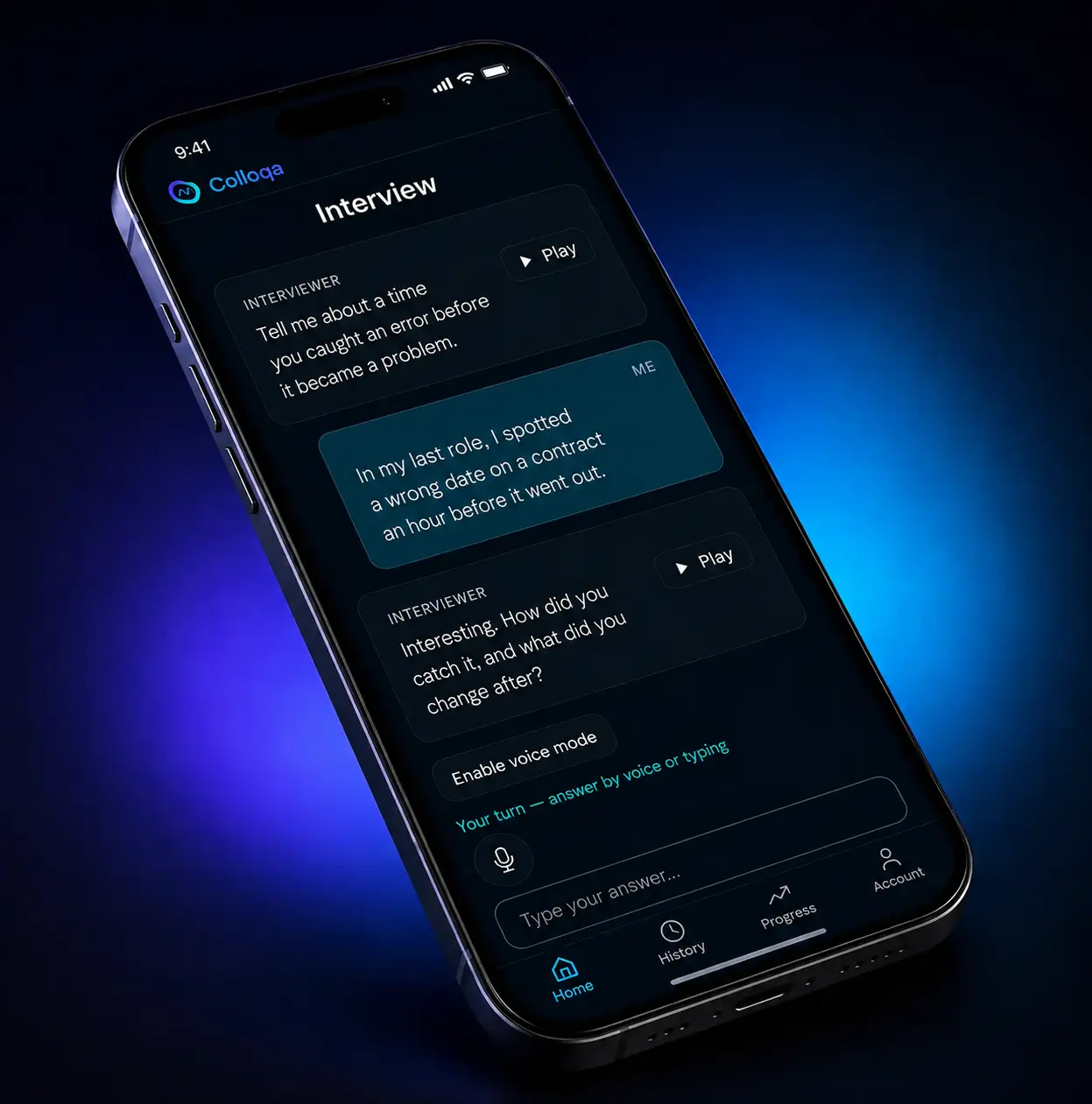
Looks useful? Run a session yourself — your transcript and feedback work the same way.
Run your first interviewHow it works
Four steps. The whole loop fits in 10 minutes.
Pick your scenario
Job interview, negotiation, hard personal talk, or the hiring manager’s seat — choose what you need to rehearse today.
Set the context in 60 seconds
A short quick-setup quiz captures who you are, what you want, who you’re talking to. The AI uses this to play the other side in character.
Practice out loud — or by typing
Voice mode in 12 languages with natural TTS / STT. The AI pushes back, probes, holds positions — like a real counterpart, not a static chatbot.
Get coaching feedback
Strengths, growth areas, and tactics to try next time. One-click "Drill this" to rehearse a specific weakness in a focused 5-8-turn session.
That's the whole loop. First session takes less than a minute to set up.
Start practicing freeQuestions administrative assistant & receptionist applicants ask us
The objections we hear most. Missing one? Email support.colloqa@gmail.com.
The ones an office manager or HR actually asks: "How do you prioritize when several people need something at once", "Tell me about a time you caught an error before it became a problem", "How do you handle confidential information", "Which software do you use — Outlook, Excel, Google Workspace", "How do you deal with a difficult caller or visitor", "Why do you want to be an administrative assistant", and "How do you stay organized when priorities change mid-day". Set your role and level in the quick setup and the AI tailors the questions and follow-ups to it.
Yes — those interviews go deeper on judgment. Expect "How do you manage an executive’s calendar when everything is a priority", "Tell me about a time you had to push back on a senior person", "How do you gatekeep without being rude", "Describe how you handled a sensitive document or conversation", and "How do you plan travel or an event end to end". Pick a middle or senior level in the setup and the interviewer probes for discretion and ownership, not just organization.
It is, and it’s one of the most common roles people rehearse here. Virtual assistant interviews mix admin questions with "How do you stay productive without supervision", "How do you handle a client in another time zone", "Which tools do you use — Slack, Asana, Trello, Notion", and a general VA, executive VA, healthcare VA, or real estate VA scenario. Paste the job post into the setup and the questions follow it.
Covered. Receptionist interviews are mostly situational: "How do you handle multiple phone lines while a visitor is waiting", "A visitor is upset and raising their voice — what do you do", "How do you keep the front desk professional when you’re swamped", and "Tell me about a time you went the extra mile for a guest or client". Voice mode matters here — reception is judged on how you sound, and you practice that out loud.
No — Colloqa rehearses the interview conversation, not the skills assessment. What it does help with is the part most people lose on: explaining your process out loud, naming the tools you actually use, and answering the behavioral and situational questions with a specific example instead of "I’m detail-oriented". If the role has a typing or Excel test, practice that separately.
Yes, and that’s a common reason people use it for admin and VA roles. Practice the interview in English to get comfortable being assessed in it, or rehearse in one of 12 supported languages first and switch. The feedback covers clarity and pace, not just what you said.
The free tier is a full AI mock interview once a day — no credit card. If your interview is days away and you want back-to-back mock interviews, drills and the detailed feedback, they come with a one-time pass: $9.99 for 1 week, $19.99 for 1 month or $49.99 for 3 months. Nothing renews, and there is a money-back guarantee (7 days; 3 days on the 1-week pass).
No more questions? One short rehearsal beats an hour of reading interview tips.
Try Colloqa freeThe conversation isn't going away.
Better to have it twice — with the AI first.
Free to start. One minute to set up. No prep required.
Start practicing free