




Rehearse your retail interview until the answers come without the nerves.
An AI interviewer that role-plays the hiring manager — customer scenarios, availability, teamwork under pressure — and follows up like a real one. Get coaching feedback and fix your weak spots before the shift interview.
No long forms. Tell it the role, start rehearsing in 60 seconds.
12 languages · Real follow-up questions · Practice out loud
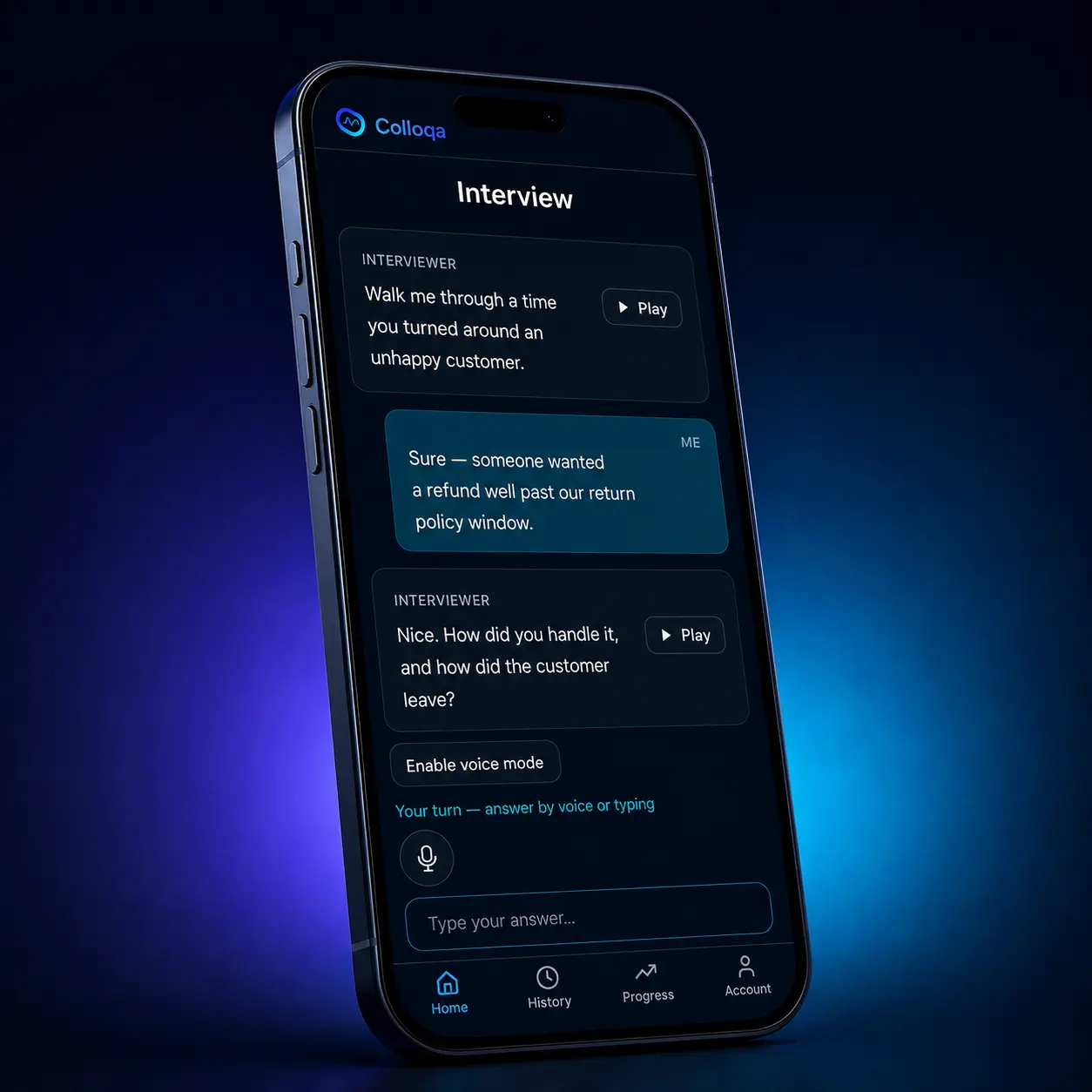
Cashier to store manager — rehearse the exact role you’re applying for
From your first part-time job to a shift-lead step up: people rehearse the real interview they’re walking into, in the format their manager will actually use.
- Retail Sales Associate
- Cashier
- Server / Waitress
- Barista
- Bartender
- Host / Hostess
- Restaurant Shift Leader
- Store Manager
- Assistant Store Manager
- Spa Receptionist
- Hotel Front Desk
- Customer Service Rep
- Call Center Agent
- Stock Associate
- Fast-Food Crew Member
- Sales Associate
16 retail interview questions (and what a strong answer sounds like)
These are the questions a retail or hospitality manager actually asks — on the shop floor, at the register, in a café or restaurant — and the ones Colloqa’s AI interviewer will ask you, with follow-ups, until the answers come out easy.
Tell me about yourself.
Keep it to the job in front of you: what you do now (school, another job, your last role), one thing that shows you’re dependable with people, and why this kind of work. Under a minute — the manager is picturing you on shift, not reading your history.
Why do you want to work here?
Managers hear “I need a job” and “I love shopping” all day. Name something specific about this store or restaurant — you’re a customer, you like how the team treats people, the product — and link it to what you’d bring on shift.
What is your availability?
Be exact: days, hours, weekends, holidays, how much notice you need. “I’m pretty flexible” sounds like a scheduling headache; a clear answer, including what you can’t do, sounds like someone who shows up.
How would you handle a customer who is angry about a return or a mistake?
They want the order of what you do: let them finish, acknowledge the actual problem, fix what you’re allowed to fix, and know when to call a manager. Mention the policy without hiding behind it.
Tell me about a time you gave a customer great service.
One real customer, what they needed, and the small extra thing you did that nobody asked for. Great service in your answer means noticing — not just being friendly.
How would you approach a customer who’s just browsing?
This is the selling question. Show how you open without pouncing, the one or two questions you’d ask to find out what they need, and how you’d suggest something that fits — including when to leave them be.
There’s a line at the register and a customer needs help on the floor. What do you do?
Talk through your priorities out loud: acknowledge the line, call for backup, tell the floor customer when you’ll be with them. The manager is checking that you stay calm and keep everyone informed, not that you can do three things at once.
Tell me about a time you worked as a team during a busy shift.
Pick a rush, a short-staffed night, or a holiday weekend, and say what you picked up without being asked. “We” is fine, but make it clear which part was yours.
Tell me about a mistake you made with a customer or an order.
A wrong order, a till that didn’t balance, a promise you couldn’t keep — pick a real one. What happened, what you did straight away to fix it, and what you do differently now. If you’ve never had a job, use school or volunteering.
Why should we hire you?
Two things the manager actually worries about — will you show up, and can you handle people — each with one piece of proof: a job or commitment you never missed, a customer or classmate situation you handled well. Thirty seconds, no list of adjectives.
A customer wants to return something without a receipt. What do you do?
Know that policy exists and that you’d check it, but answer with the tone first: find out what they want (refund, exchange, credit), explain the options you’re allowed to offer, and get a manager when it’s outside them. The wrong answer is either “no” on the spot or giving the refund to end the conversation.
What would you do if you saw a coworker giving away free items or taking from the till?
An integrity question with one answer: you don’t join in, you don’t cover for it, and you tell the manager privately. Say it plainly and briefly — hedging here costs more than any other answer in the interview.
How do you handle a long shift on your feet when it’s busy?
Managers want to hear a routine, not toughness: how you pace yourself, what you do in the quiet ten minutes, and that you ask for a break instead of fading. A shift you got through — a holiday weekend, a stock delivery day — is the proof.
Tell me about a time you suggested an extra item or an upgrade to a customer.
Even non-sales retail roles are measured on add-ons. Describe how you noticed what the customer was buying, the one suggestion that fit, and how you took the “no” gracefully. It shows you sell by helping, not by pushing.
Your till is short at the end of the shift. What do you do?
Recount, then report it immediately and honestly — to the manager, before you leave. Mention what you check during the shift (change given, voids, card receipts) so it rarely happens. Never “I’d make it up myself”.
Do you have any questions for us?
Always have two. Ask what a typical shift looks like, how training works for new starters, or what the best people on the team do differently. It shows you’re already picturing the job.
Reading them is not the same as answering them out loud with a store manager waiting.
Rehearse these out loudBuilt for the days before the interview
Three situations Colloqa is made for. If one sounds like this week — start there.

It’s your first real interview and you don’t know what they’ll ask
Availability, how you’d handle a rude customer, why you want the job — the questions are predictable, but freezing on them is common. Rehearse the exact ones tonight so you walk in already having answered them.

You keep getting the "tell me about a time a customer…" curveballs
Customer-conflict and teamwork stories are where most people ramble. Practice telling one crisp story, get told exactly where it dragged, and tighten it until it lands in 60 seconds.

You’re stepping up — crew to shift lead, associate to manager
The questions change when you’re interviewing to lead: handling staff, hitting targets, covering a bad shift. Rehearse the manager-level format instead of the one you aced two years ago.
What makes the rehearsal worth 15 minutes
Six things that turn talking-to-a-bot into actual interview prep for a customer-facing role.
An interviewer that actually follows up
Real hiring managers dig in. Colloqa does too — "What did the customer say back?" — so you practice thinking on your feet instead of reciting lines.
Practice out loud — voice mode
Customer-facing roles are judged on how you come across. Rehearse your tone and warmth out loud, not just in your head.
Behavioral, situational, or mixed
Pick the format your interview runs — "tell me about a time", a difficult-customer role-play, or a realistic blend of both.
Coaching feedback, not a transcript
After each session: what landed, what to fix, and how to say it — availability, reliability, and customer scenarios.
Drill the one thing you fumbled
Blanked on the "angry customer" question? One tap turns it into a short, focused drill so you nail it before the shift interview.
Watch your readiness trend up
Re-run the questions and watch your score climb across attempts. Built for the week before the interview — not a one-shot demo.
Walk in feeling like you’ve done this shift interview twice already — because you have.
Practice freeWhat a rehearsal actually looks like
A real opening question, your answer, an honest follow-up — then written coaching at the end.
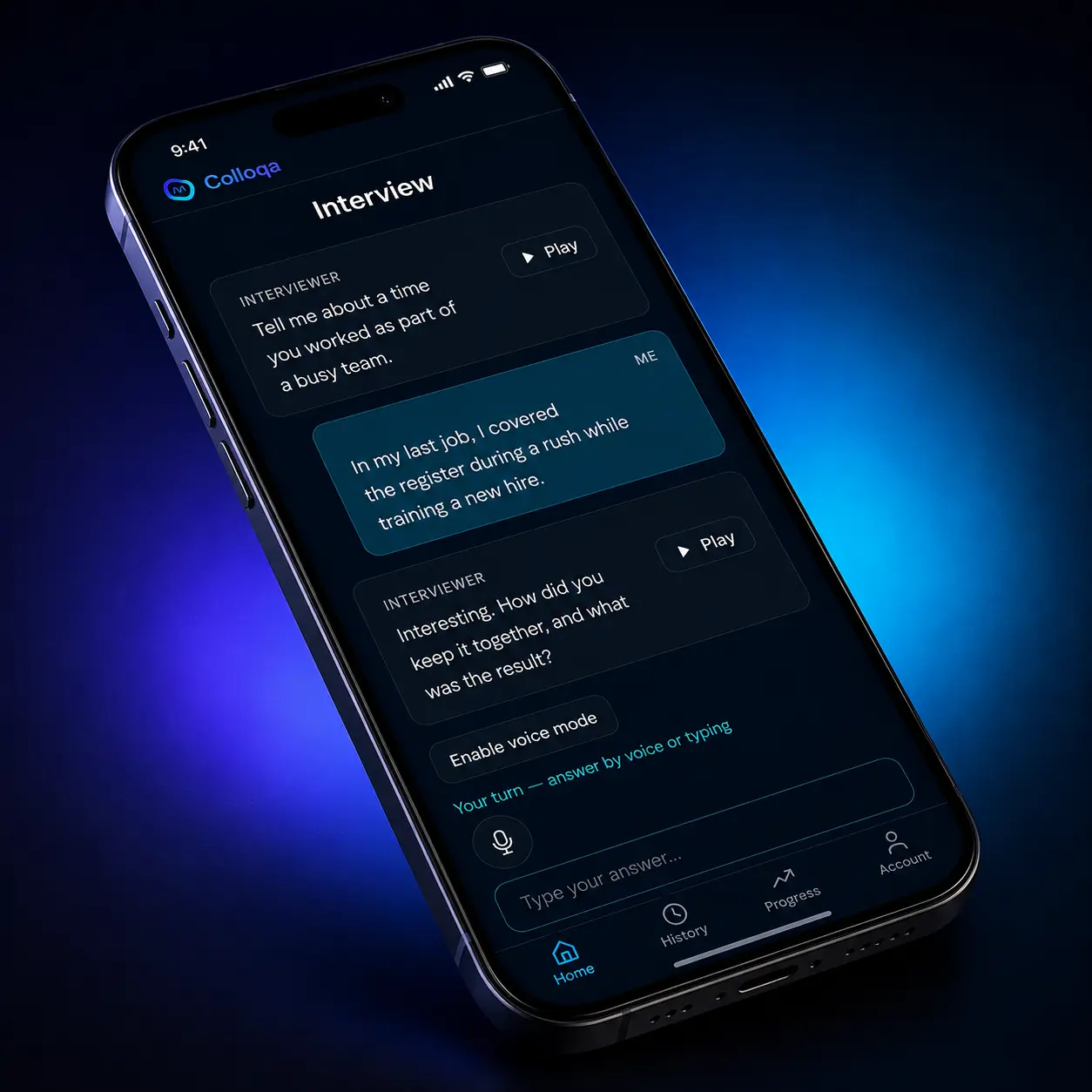
Looks useful? Run a session yourself — your transcript and feedback work the same way.
Run your first interviewHow it works
Four steps. The whole loop fits in 10 minutes.
Pick your scenario
Job interview, negotiation, hard personal talk, or the hiring manager’s seat — choose what you need to rehearse today.
Set the context in 60 seconds
A short quick-setup quiz captures who you are, what you want, who you’re talking to. The AI uses this to play the other side in character.
Practice out loud — or by typing
Voice mode in 12 languages with natural TTS / STT. The AI pushes back, probes, holds positions — like a real counterpart, not a static chatbot.
Get coaching feedback
Strengths, growth areas, and tactics to try next time. One-click "Drill this" to rehearse a specific weakness in a focused 5-8-turn session.
That's the whole loop. First session takes less than a minute to set up.
Start practicing freeQuestions retail & hospitality applicants ask us
The objections we hear most. Missing one? Email support.colloqa@gmail.com.
Yes — those are the core of a retail or hospitality interview and Colloqa leans into them. It role-plays customer-conflict scenarios, teamwork-under-pressure stories, availability, and reliability questions, then follows up the way a real hiring manager would ("What did the customer say back?").
That’s exactly who it helps most. First interviews feel scary because they’re unfamiliar, not because they’re hard. Running two or three practice rounds makes the questions predictable, so on the day it feels like something you’ve already done.
You can paste any context you have — the role, the company, anything from the job post. The AI uses it to colour its questions. It won’t invent insider details it doesn’t have, so the practice stays realistic.
Three things: an interviewer persona that pushes back instead of being polite, voice mode so you actually talk out loud (huge for customer-facing roles), and structured coaching at the end — strengths, growth areas, drill targets — not just a transcript.
Either. Voice mode is there because saying your answers out loud is the closest thing to the real interview — but if you’re somewhere you can’t talk, you can type and still get the same follow-ups and feedback.
The free tier is a full AI mock interview once a day — no credit card. If you have an interview coming up fast and want back-to-back mock interviews, drills and the detailed feedback, they come with a one-time pass: $9.99 for 1 week, $19.99 for 1 month or $49.99 for 3 months. Nothing renews, and there is a money-back guarantee (7 days; 3 days on the 1-week pass).
No more questions? One short rehearsal beats an hour of reading interview tips.
Try Colloqa freeThe conversation isn't going away.
Better to have it twice — with the AI first.
Free to start. One minute to set up. No prep required.
Start practicing free